
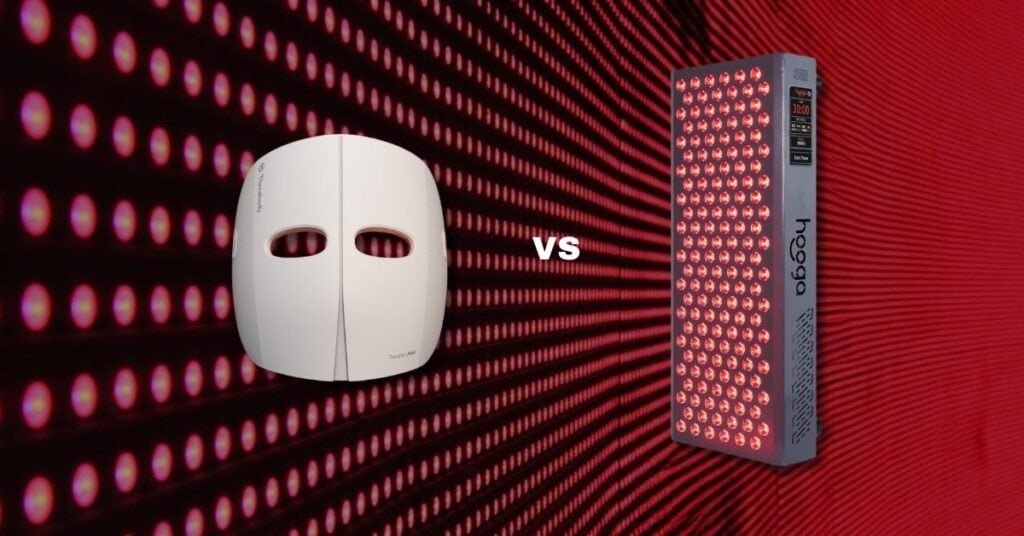
Red light therapy is everywhere, but it is not just a fad and is here to stay, as it can be beneficial when used correctly and consistently. I’m in my early 40s, and this feels like a good time to invest in a device, but before spending a small fortune, I wanted to understand what fits my needs better: a red light therapy mask or a panel.
If you can’t decide between a red light face mask or a panel, this guide breaks down the real differences, the specs that matter, and how to choose the right option for your goals.
TL;DR: mask or panel?
Choose a red light therapy mask if:
Your main goal is face-focused skin results (fine lines, tone, texture, acne support)
You want maximum convenience and minimal setup
You travel often or want something easy to use consistently
Choose a red light therapy panel if:
You want to treat face + body (recovery, joints, larger skin areas)
You want more versatility and coverage
You are comfortable managing distance, time, and setup
Mask vs panel comparison table
| Feature | Red light mask | Red light panel |
|---|---|---|
| Best for | Face-focused skin goals (texture, tone, fine lines, acne support) | Face + body (larger skin areas, muscles, joints, recovery) |
| Treatment area | Mostly face (sometimes neck) | Flexible - face, neck, back, joints, legs, scalp |
| Ease of use | Easiest - fixed distance, usually built-in timer | More setup - distance, angle, and timing matter |
| Comfort | Can feel heavy or fit poorly; heat/pressure points vary | No face contact, but you usually sit still and use goggles |
| Room for error | Low (distance is fixed) | Higher (too close/too far, inconsistent dosing) |
| Eye safety | Built-in, eye cutouts | Higher priority - bright source at eye level; goggles recommended |
| Portability | High | Low to medium (size-dependent) |
| Space needed | Minimal | More (stand/mount + storage) |
| Acne support | Some include blue light | Blue light is uncommon |
| “Value per coverage” | Lower (small area) | Higher (covers more area over time) |
| Typical price range | Lower to mid | Mid to high (increases with size/output) |
Red Light Masks vs panels - the real differences that matter
1) Primary purpose and typical use cases
Although both use red light therapy, they are designed for different priorities.
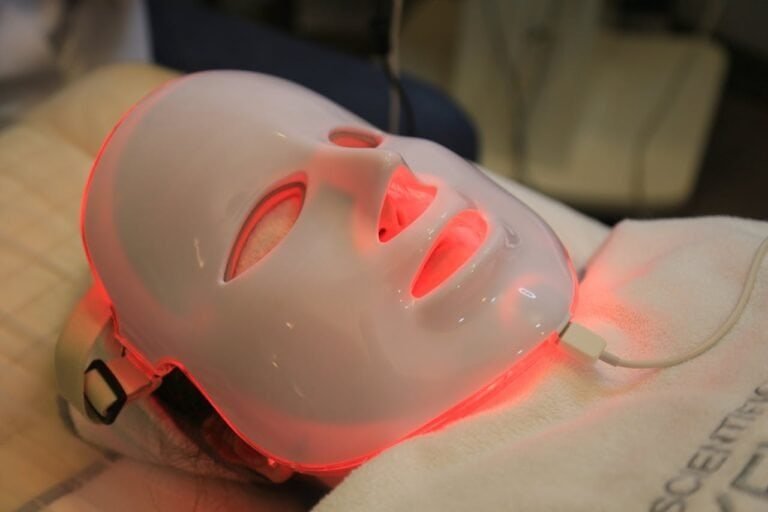
Masks are for skin-focused goals, especially the face. The shape and LED placement are designed to sit close to the skin and cover facial contours, which makes them very easy to use as part of a skincare routine.
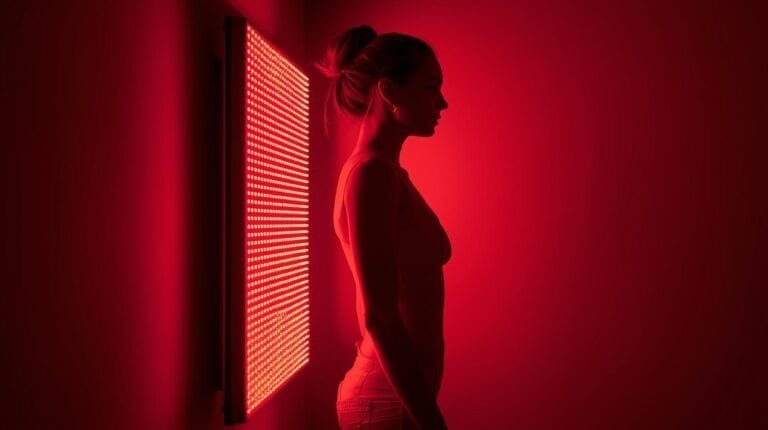
Panels are typically built to treat larger areas and are often used for both skin and deeper tissues (muscle recovery, joints). Because panels are used from a distance and cover more surface area, they tend to be larger and can be more powerful – but they also require more setup.
2) Ease of use and comfort
Red Light Masks are more portable and easier to use. Many are cordless, so you can wear them while doing different activities at home like reading, watching TV or even cooking. Comfort varies, though:
- Some masks can be heavy
- Some do not fit well
- Some create pressure points around the nose or brow
Before buying, check comfort and fit feedback in reviews and pick a mask that will fit your face shape.
Red Light Panels require more intention:
- You need to position yourself at a consistent distance
- You often need protective goggles
- You usually cannot read, scroll, or move around much during use
If you know you will struggle to sit still, that matters more than the highest specs.
3) Coverage: face-only vs face and body
Masks are primarily for the face (sometimes face + neck). They are more targeted, and some designs concentrate LEDs in areas that need more attention. For example crows feet, around eyes and smile lines.
Panels can be used on face and décolletage, neck and back, joints, arms, legs, scalp.
They are more flexible, but you need to be more precise with distance and angle.
4) Acne support and blue light
Many masks include blue light to target acne. Most panels do not include blue light.
If acne is your main concern, and you want the simplest option for facial acne, a mask is often the more practical choice.
5) Maintenance
Masks: because they touch your face, they need more frequent cleaning (oil, skincare, makeup residue). They also need recharging as they are portable.
Panels: mainly need dusting and surface cleaning. Keep vents clear and wipe the surface regularly.
6) Cost and long-term value
A quality red light therapy device should last a long time. Many masks and panels come with 1-2 year warranties. Panels are often a longer-term investment because they can treat more areas, but the best value is the device you will actually use consistently.
Pros and cons of red light masks and panels
Red light therapy masks
Pros
- Hands-free and simple – put it on, press start, done
- Face-specific results – targets common goals (fine lines, texture, tone, acne support)
- Less setup, fewer variables – fixed distance from skin, usually built-in timer
- Lower entry cost – generally cheaper than quality panels
- Easy to store and travel with – small footprint
- Good for consistency – easier to stick to a routine
- Often gentler – easier to avoid overdoing it compared to powerful panels
Cons
- Limited treatment area – mostly face (sometimes neck), not ideal for body recovery
- Fit and comfort issues – pressure points, heaviness, heat, strap discomfort
- Uneven coverage risk – gaps if the shape does not match your face (nose, jawline, under eyes)
- Eye comfort can be tricky – light leakage or intensity without proper shielding
- Less flexibility – you can’t adjust distance, angles, or easily treat other areas
- Hygiene and maintenance – needs cleaning; returns can be limited for hygiene reasons
- Value per coverage – cost per treated area can be worse than panels over time
Red light therapy panels
Pros
Most versatile – face, neck, back, joints, legs, scalp
Better for full-body goals – muscle recovery, soreness, joint support, larger skin areas
More coverage per session – especially with mid/large panels
Adjustable dosing – you can change distance, session length, and angles
Better long-term value – higher upfront cost, but better “cost per area treated”
Often stronger output – can deliver more light at useful distances (varies by brand)
Multiple mounting options – stand, door mount, wall mount (depending on model)
Cons
More setup and space – stand/mount, room position, storage
More room for user error – distance, time, consistency, treating too close or too long
Eye safety is a bigger consideration – goggles are more relevant because you face a bright source
Less travel-friendly – bulky and heavier
Noise/heat – some have fans, can be loud or run hot
Costs add up – stands/mounts, goggles, and larger sizes increase total price
Harder to be consistent – if setup is annoying, people use it less
You Might Also Like:
Key specs to understand before buying a red light mask or panel
Most common wavelengths in red light therapy
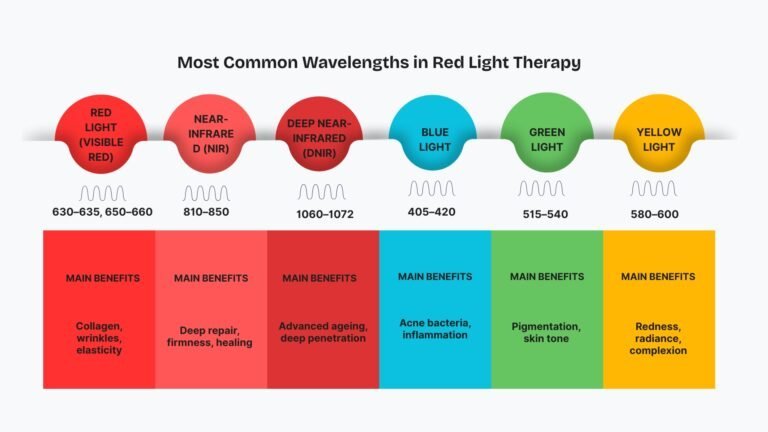
Most of the red light therapy literature concentrates on 630-680 nm (red) and 800-830 nm (near-infrared), with 810 nm especially prominent; 904 nm pulsed is also well studied. Blue/green/amber are actively researched but remain secondary.
Band – Typical peaks most studied – Example uses
Red – 630-635, 650-660, 680-685 nm – Skin, wounds, hair, myopia, endothelial, stem cells
NIR – 780-810, especially 800-830, 808-810; 904 nm – Wounds, bone, cardiovascular/endothelial, retinal.
Blue light (≈400-470 nm). Blue light therapy shows antimicrobial, anti-inflammatory, and skin-rejuvenating effects across various skin conditions therefore is great for trating acne. (9)
Although some masks include many additional colours (green, yellow, white, purple), they may have potential benefits, but there are fewer studies to support many of the at-home claims.
Proven red and infrared light therapy benefits
Skin rejuvenation and anti-aging
Multiple clinical trials find that low-level red/near-infrared light improves wrinkles, texture, and dyschromia, and is considered a safe, effective method of skin rejuvenation. (1).
Alopecia (hair loss)
Both red and green light have shown benefits for hair loss, with red light being more effective (2). Red light therapy can help with hair regrowth, but it is not a miracle and should be used to enhance other hair growth treatments.
Wound healing and tissue repair
Both red and NIR light have proven to aid wound healing. (6)
Eye health and myopia
This is one of the most confusing areas. There are studies showing benefits in controlled environments with low-level red light (~650 nm)(5). But many red light panels recommend protective goggles, and many red light masks have eye cut-outs.
What can be harmful to the eyes is typically intensity and exposure, not “red light” as a category. Never look directly into the light, and follow the manufacturer’s guidelines – especially when using near-infrared together with red.
Brain, mood, and vascular function
Many users report better mood, but these claims still need larger studies. Overall, red/near-infrared shows clinically meaningful antidepressant effects with good safety, but evidence and dosing protocols are still evolving. These are best viewed as promising, but not replacements for standard depression care (7)(8).
Is pulsing worth it in at-home red light panels and masks?
Laboratory studies show that pulsed red and near-infrared light can affect cells differently from continuous light. In controlled settings, specific pulsing patterns have been shown to slightly enhance mitochondrial activity and cellular energy production compared to continuous light.
However, these findings do not automatically translate to at-home red light devices.
Most at-home red light panels and masks have low power outputs and do not meaningfully increase peak power when pulsing. In many cases, “pulse mode” simply turns the LEDs on and off without changing how much light reaches the tissue overall. When peak power is not higher, pulsing offers no advantage and may even reduce the effects of continuous light.
For skin goals like collagen support, redness, acne, or general skin health, there is currently no strong human evidence showing that pulsed light is better than continuous light.
Bottom line: for most at-home red light panels and masks, pulsing is not essential and should not be a deciding factor. A well-designed device delivering sufficient light at proven wavelengths, used consistently, is likely to provide better benefits than pulsed mode. (3)(4)
Who should not use red light therapy?
Red light therapy is generally considered safe, but there are situations where you should avoid it or get medical guidance first.
Avoid red light therapy without medical guidance if you:
- Have a known photosensitivity disorder (for example, porphyria or lupus-related photosensitivity)
- Are you taking photosensitising medications
- Have active skin cancer or a history where your clinician has advised avoiding light/heat-based therapies
- Have epilepsy triggered by flashing lights (especially relevant if your device has pulsing)
- Have a serious eye disease or you are recovering from recent eye surgery
- Have a medical condition where heat worsens symptoms (some devices can get warm during use)
Use extra caution and start low if you:
- Are pregnant (evidence is limited for at-home cosmetic use; many brands recommend clinician guidance)
- Have melasma or hyperpigmentation-prone skin (heat can be a trigger for some people)
- Have rosacea or very reactive skin (start with shorter sessions and lower frequency)
- Have thyroid concerns (avoid prolonged direct exposure over the thyroid area unless your clinician says it’s fine)
Red light mask or panel: what should you buy?
The simplest way to decide is to start with your main goal.
If your primary focus is anti-aging or acne treatment on your face, a mask can be the simplest option.
If your main goal is versatility – face + body, recovery, joint support – a panel gives you more flexibility.
Red light therapy requires consistency, so before buying, ask yourself: what device will you realistically use most often?
If you cannot sit still with goggles or eyes closed, a mask may be the better option. If you want to treat more than your face, a panel is usually the more versatile choice.
Or, you might even want to get both. I am starting with face mask and see if I can stick with it, and if I will enjoy using it, I will invest into a panel and see if it can help with my back and muscle aces.
FAQ about red light therapy masks and panels
Is red light therapy safe?
Yes, it is widely studied and generally considered safe when used correctly. A few points still matter:
Follow the manufacturer’s guidance for session length and frequency – more is not better. Avoid staring directly at the LEDs. Prioritise brands that provide clear specs, testing, and a strong warranty.
When will I see results?
Red light therapy is a long game. Some people notice changes within 2 weeks, but most meaningful skin changes take weeks to a few months of consistent use.
Can I use red light therapy for my pet?
Yes, but do not allow pets to stare directly into the light. Red light therapy may support skin/fur and joint comfort.
Do red light devices become less effective over time?
Yes, but most people will not notice it. Manufacturers often rate LEDs for tens of thousands of hours (commonly ~30,000-50,000+). Real-world lifespan depends on heat management and build quality. Even at 10 minutes per day you use roughly 60 hours per year, so it can take many years before output loss becomes meaningful.
Please note: this post is for informational purposes only and is not medical advice. Always consult a healthcare professional before starting any supplement.
References
- Glass, G. (2021). Photobiomodulation: The Clinical Applications of Low-Level Light Therapy.. Aesthetic surgery journal. https://doi.org/10.1093/asj/sjab025.
- Tantiyavarong J, Charoensuksira S, Meephansan J, Hanvivattanakul S, Rayanasukha Y, Boonkoom T, Tantisantisom K. Red and Green LED Light Therapy: A Comparative Study in Androgenetic Alopecia. Photodermatol Photoimmunol Photomed. 2024 Nov;40(6):e13004. doi: 10.1111/phpp.13004. PMID: 39368074. https://pubmed.ncbi.nlm.nih.gov/39368074/
- Tang, L.; Qin, H.; Lin, S.; Liu, M. Effects of Pulsed Red and Near-Infrared Light on Neuroblastoma Cells—Pilot Study on Frequency and Duty Cycle. Photonics 2023, 10, 315. https://doi.org/10.3390/photonics10030315
- Hashmi JT, Huang YY, Sharma SK, Kurup DB, De Taboada L, Carroll JD, Hamblin MR. Effect of pulsing in low-level light therapy. Lasers Surg Med. 2010 Aug;42(6):450-66. doi: 10.1002/lsm.20950. PMID: 20662021; PMCID: PMC2933784. https://pmc.ncbi.nlm.nih.gov/articles/PMC2933784/
- Jiang, Y., Zhu, Z., Tan, X., Kong, X., Zhong, H., Zhang, J., Xiong, R., Yuan, Y., Zeng, J., Morgan, I., & He, M. (2021). Effect of Repeated Low-Level Red-Light Therapy in Myopia Control in Children: A Multicenter Randomized Controlled Trial.. Ophthalmology. https://doi.org/10.1016/j.ophtha.2021.11.023.
- Yadav, A., & Gupta, A. (2017). Noninvasive red and near‐infrared wavelength‐induced photobiomodulation: promoting impaired cutaneous wound healing. Photodermatology, 33. https://doi.org/10.1111/phpp.12282.
- Ji, Q., Yan, S., Ding, J., Zeng, X., Liu, Z., Zhou, T., Wu, Z., Wei, W., Li, H., Liu, S., & Ai, S. (2024). Photobiomodulation improves depression symptoms: a systematic review and meta-analysis of randomized controlled trials. Frontiers in Psychiatry, 14. https://doi.org/10.3389/fpsyt.2023.1267415.
- Caldieraro, M., & Cassano, P. (2019). Transcranial and systemic photobiomodulation for major depressive disorder: A systematic review of efficacy, tolerability and biological mechanisms.. Journal of affective disorders, 243, 262-273 . https://doi.org/10.1016/j.jad.2018.09.048.
- Lodi, G., Cassalia, F., Sannino, M., Cannarozzo, G., Baroni, A., Amato, S., Zappia, E., Pellacani, G., & Nisticò, S. (2025). Blue Light Therapy in Dermatological Practice: A Review. Cosmetics. https://doi.org/10.3390/cosmetics12010030.

Silvija Meilunaite, PN1-NC, CSMC, is a certified nutrition coach and menopause coaching specialist writing from personal experience of perimenopause. She covers midlife health, hormone-supportive nutrition, and non-toxic living with a research-driven approach, helping women over 40 feel informed, strong, and healthy.