
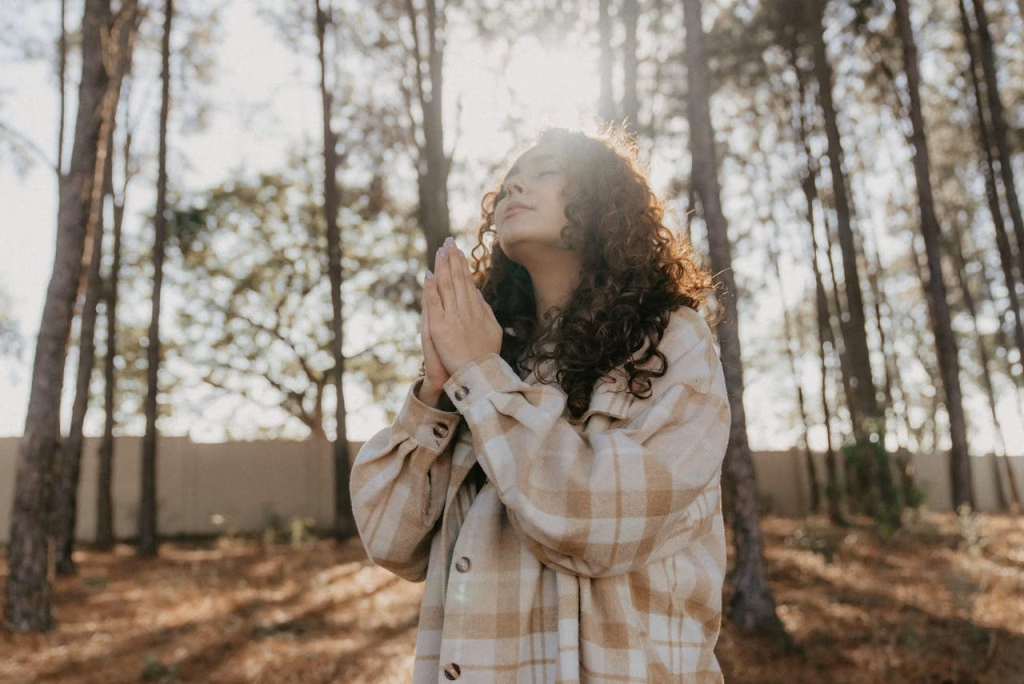
When I turned 40, something shifted. Not just physically (though perimenopause was certainly making itself known) but also mentally. I started questioning everything. Is this the career I want? Am I where I thought I’d be? Is this it?
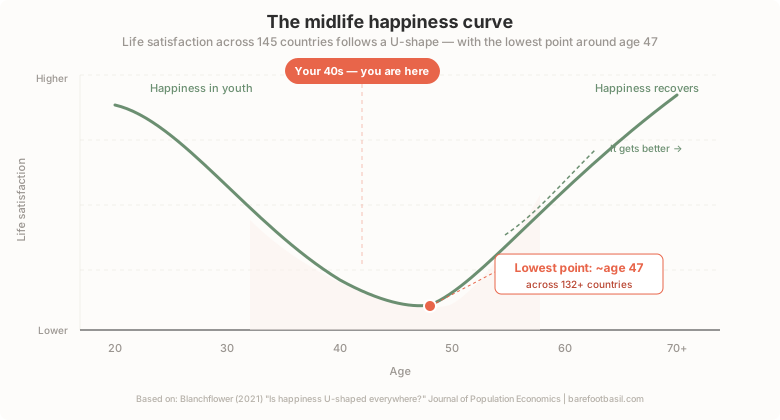
If you’re nodding, you’re not alone. Research shows that life satisfaction follows a U-shape; it dips to its lowest point somewhere in your mid-40s before climbing back up. It even has a name: the midlife happiness curve. It happens across cultures, income levels, and life circumstances. Something about this stage of life makes us rethink our lives and question everything.
I kept hearing about gratitude practice. For years, I dismissed it as a bit fluffy. But when I actually committed to it (five minutes a day, consistently), something shifted. Not overnight, but steadily.
I want to share what gratitude practice actually is, why the science says it works, and why I think it’s especially powerful for women navigating their 40s, when the questioning is loudest, and the mood dips are real.
What Is Gratitude Practice?
Gratitude is recognizing and appreciating life’s positive aspects, big or small. Gratitude is focusing and appreciating what we have instead of what we lack, fostering a feeling of fulfillment and happiness. Gratitude is more than just saying “thank you;” it is a mindset of appreciation that helps us see challenges as opportunities for growth. Gratitude also helps us improve our relationships with others.
Gratitude is highlighted in religions where gratitude is given to God. Gratitude to God or Gods is prominent in Catholic, Buddhist, Muslim, Hindu, and Jewish religions. Although gratitude is practiced in many religions and is highlighted by many spiritual leaders, it is important to practice if you are not religious.
Instead of being grateful to a God, you can be just appreciative and focus on your purpose or purposes in your life.
Ultimately, gratitude is about developing an attitude of thankfulness and appreciating the value of our experiences and surroundings.
Proven Benefits of Gratitude Practice
Mental and Emotional Health Improvements
Studies show that gratitude impacts mental and emotional well-being. For example, research by Emmons and McCullough found that participants who kept gratitude journals for 10 weeks reported 25% higher happiness levels than those who focused on daily burdens. (4)
Similarly, a study published in the Journal of Positive Psychology revealed that practicing gratitude can reduce symptoms of depression and anxiety by promoting a positive outlook on life.(6)
Physical Health
In a study published in Applied Psychology: Health and Well-Being, participants who wrote in a gratitude journal before bed experienced better quality sleep and fell asleep faster.(7)(2)
Another study in Frontiers in Psychology showed that gratitude practices lower stress(5) and improve overall well-being.(8)(2)
Social Well-Being
Showing gratitude strengthens close relationships by increasing trust and emotional closeness. A 2010 study published in Emotion found that individuals who expressed gratitude to their partners not only felt more satisfied in the relationship but also helped their partners feel more valued and committed.(9) Furthermore, gratitude encourages acts of kindness and cooperation. (2)
Optimism and Sense of Purpose
Gratitude helps to stay more optimistic (3). Research in Psychological Science shows that people who practice gratitude experience higher life satisfaction, happiness, and purpose, even during difficult times.(10)
Why your 40s are when gratitude practice matters most
There’s a reason this decade hits differently. At 40, most of us are juggling more than we ever have: careers, relationships, ageing parents, possibly kids, health changes, and a growing awareness that time isn’t infinite. Layer on the physical changes of perimenopause, disrupted sleep, anxiety, mood swings, and brain fog, and you start feeling stuck, lost, or just flat.
The midlife happiness dip isn’t a personal failure. Economists and psychologists have documented it across 132 countries: life satisfaction bottoms out around age 47 on average, regardless of income or marital status (11). It’s not that your life is objectively worse; it’s that the gap between expectations and reality can feel widest at this point (11)(12).
This is exactly where gratitude practice becomes very helpful. Not as toxic positivity or pretending everything is fine, but as a deliberate reframing of your mindset. When your brain is stuck in “is this it?” mode, gratitude interrupts the loop.
Studies show it activates the brain’s reward system and increases serotonin and dopamine, which is particularly useful when perimenopause is already disrupting those same neurotransmitters.
I also found gratitude helpful for something less discussed: the identity shift. At 40, you’re not who you were at 30, and you’re not yet who you’ll be at 50. You are not young, but not old; you are stuck in the middle. That in-between space can feel uncomfortable. Gratitude doesn’t fix it, but it anchors you in what’s actually here and working, rather than what’s missing or lost.
The research backs this up. A study in the Journal of Happiness Studies found that gratitude practice improved well-being and a sense of meaning in life (3). For women in midlife, where meaning and purpose often come into question, that’s not trivial.
How To Practice Gratitude?
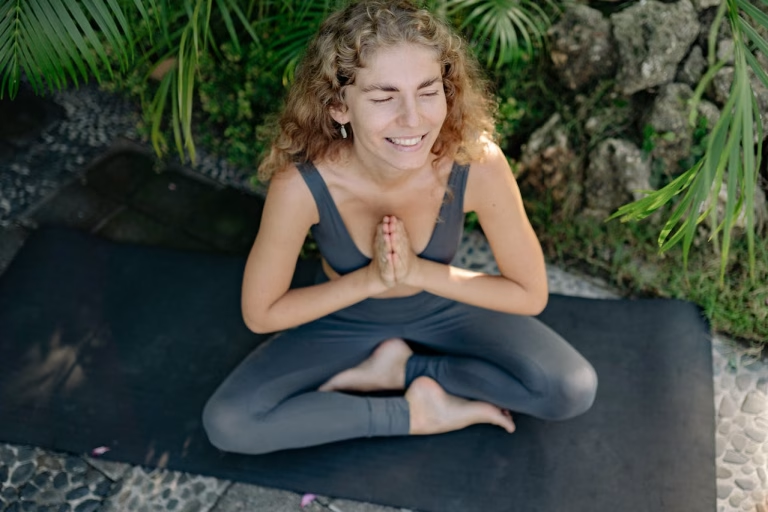
Practicing gratitude doesn’t have to be time-consuming or expensive. All you need is 5 minutes in your day. You can be grateful in your thoughts; you can say it out loud, write in your journal on your phone, or on paper. You can also create a friend group or chat where you all express a few things for which you are grateful daily. Or you can join an existing gratitude community online, like this one on Reddit.
The best way to practice gratitude is in the morning; you can do it in bed as soon as you wake up. Or reflect on the day and practice gratitude in the evening before bed. I do it in the morning, but some people prefer to practice gratitude in the evening after the day is finished.
Ideally, you want to express gratitude for 3 to 5 new things daily. Gratitude can be expressed in multiple areas of our lives; here are a few to get you started:
- Personal– focusing on our values, behaviors, abilities, and accomplishments.
- Interpersonal– directed towards others, appreciating people in your life, their support, and kindness.
- Environmental- appreciating nature and the world around us
- Situational- appreciating beautiful events and moments in our lives and being grateful even during hard times, as they often show us valuable lessons and opportunities for growth.
- Material – appreciating things we have
- Spiritual can be related to religion and being grateful for a connection to someone bigger or a sense of purpose in life.
- Global or Societal – being grateful for new inventions or people that make our life on the planet beautiful.
Gratitude isn’t just about listing things, it’s about truly appreciating them. To deepen your practice, reflect on why you’re grateful for something and how it makes you feel. For example, instead of just noting, ‘I’m grateful for my partner,’ think about how their support makes you feel loved, safe, or inspired to grow.
You can also be grateful not only for ‘positive’ things in life, but also for challenges and hardships. Why? Because they make you grow and develop.
Other examples:
I am grateful for a rainy day because it makes me appreciate the sunshine more; the rain also waters the plants and washes off the dust of the streets.
I appreciate the beautiful meal we had as a family; it nourished our bodies, tasted delicious, and made us bond.
To make gratitude practice helpful, practice it daily, so find a way that suits you. My partner and I like to share what we are grateful for, which makes the gratitude practice even more powerful.
If you are unsure where to start, join 31 Days of Gratitude on our Instagram.
You can start at any time and think of one to 5 things you are grateful for each day.
The Most Beneficial and Science-based Gratitude Practice
Studies have shown that the most beneficial practice of gratitude is not being grateful but receiving gratitude from others. How can you implement it in your life? Well, express gratitude to others so they feel the benefits. Do good things for others so you receive the gratitude back.
Do little acts of kindness, like buying a sandwich or a coffee for a homeless person, or helping an old lady carrying bags, to receive gratitude.
A scientifically proven way to practice gratitude is to imagine a story of kindness and think about how the receiver of appreciation would have felt in the situation. It can be you or another person being thanked for a specific act of kindness.
Repeat this practice for five to five minutes daily to revive your brain for a more positive outlook. Ensure that the story you keep repeating for yourself is meaningful and makes you feel grateful; you can’t lie about it and reap the benefits; you have to feel it.
Andrew Huberman explains this practice very clearly in his video :
Gratitude has been known for thousands of years to enhance our lives, give a more positive outlook, and make us more connected and happy. It is a very short practice that can rewire our brain for life, from one to five minutes a day. It doesn’t matter what you do, but try practicing gratitude daily to build a long-term habit and reap the rewards. Try practicing different ways of being grateful, from appreciating what you have to imagine a scenario or replaying a memory of gratefulness, and see what works best for you.
If you want to learn more about practices that enhance your well-being, check out:
Do you practice gratitude? How do you do it? Leave a comment below; I would love to hear it.
Please Note: This post is for informational purposes only and is based on research. It’s not medical advice. It’s always best to consult a healthcare professional with health concerns. Enjoy reading!
References and links
- Boggiss, A., Consedine, N., Brenton-Peters, J., Hofman, P., & Serlachius, A. (2020). A systematic review of gratitude interventions: Effects on physical health and health behaviors.. Journal of psychosomatic research, 135, 110165 . https://doi.org/10.1016/j.jpsychores.2020.110165.
- Czyżowska, N., & Gurba, E. (2022). Enhancing Meaning in Life and Psychological Well-Being Among a European Cohort of Young Adults via a Gratitude Intervention. Frontiers in Psychology, 12. https://doi.org/10.3389/fpsyg.2021.751081.
- Bohlmeijer, E., Kraiss, J., Watkins, P., & Schotanus-Dijkstra, M. (2020). Promoting Gratitude as a Resource for Sustainable Mental Health: Results of a 3-Armed Randomized Controlled Trial up to 6 Months Follow-up. Journal of Happiness Studies, 1-22. https://doi.org/10.1007/s10902-020-00261-5.
- Emmons, R., & McCullough, M. (2003). Counting blessings versus burdens: an experimental investigation of gratitude and subjective well-being in daily life.. Journal of personality and social psychology, 84 2, 377-89 . https://doi.org/10.1037/0022-3514.84.2.377.
- Fekete EM, Deichert NT. A Brief Gratitude Writing Intervention Decreased Stress and Negative Affect During the COVID-19 Pandemic. J Happiness Stud. 2022;23(6):2427-2448. doi: 10.1007/s10902-022-00505-6. Epub 2022 Feb 24. PMID: 35228834; PMCID: PMC8867461. https://pmc.ncbi.nlm.nih.gov/articles/PMC8867461/
- Alex M. Wood, Jeffrey J. Froh, Adam W.A. Geraghty, Gratitude and well-being: A review and theoretical integration, Clinical Psychology Review, Volume 30, Issue 7,2010 , Pages 890-905 , ISSN 0272-7358, https://doi.org/10.1016/j.cpr.2010.03.005.
- Jackowska M, Brown J, Ronaldson A, Steptoe A. The impact of a brief gratitude intervention on subjective well-being, biology and sleep. J Health Psychol. 2016 Oct;21(10):2207-17. doi: 10.1177/1359105315572455. Epub 2015 Mar 2. PMID: 25736389.https://pubmed.ncbi.nlm.nih.gov/25736389/
- O’Leary K, Dockray S. The effects of two novel gratitude and mindfulness interventions on well-being. Journal of Alternative and Complementary Medicine (New York, N.Y.). 2015 Apr;21(4):243-245. DOI: 10.1089/acm.2014.0119. PMID: 25826108.https://europepmc.org/article/med/25826108
- Lambert, N. M., et al. (2010):Expressing gratitude to a partner leads to relationship well-being.https://clarkrelationshiplab.yale.edu/sites/default/files/files/Benefits%20of%20expressing%20gratitude_%20Expressing%20gratitude%20to%20a%20partner%20changes%20one’s%20view%20of%20the%20relationship.pdf
- Kerr, Shelly & O’Donovan, Analise & Pepping, Christopher. (2014). Can Gratitude and Kindness Interventions Enhance Well-being in a Clinical Sample?. Journal of Happiness Studies. 10.1007/s/10902-013-9492-1. https://www.researchgate.net/publication/262725937_Can_Gratitude_and_Kindness_Interventions_Enhance_Well-being_in_a_Clinical_Sample
- Blanchflower, D.G. (2021). Is happiness U-shaped everywhere? Age and subjective well-being in 145 countries. Journal of Population Economics, 34(2), 575–624. https://link.springer.com/article/10.1007/s00148-020-00797-z
- Blanchflower, D.G. & Oswald, A.J. (2008). Is well-being U-shaped over the life cycle? Social Science & Medicine, 66(8), 1733–1749. https://doi.org/10.1016/j.socscimed.2008.01.030
- Rauch, J. (2018). The Happiness Curve: Why Life Gets Better After 50. Thomas Dunne Books.

Silvija Meilunaite, PN1-NC, CSMC, is a certified nutrition coach and menopause coaching specialist. Combining current scientific research with her own experience of perimenopause, she writes evidence-based articles, practical guides, and in-depth product reviews to help women over 40 make informed decisions about nutrition, strength training, recovery, supplements, non-toxic living, and wellness products.

I love practising gratitude in the morning. It is amazing to see that more people understand the benefits of practising gratitude. Thank you for an insightful article.
This article is amazing! I used to practice gratitude but forgot about it for a while. Thank you for reminding me about it.