By the time I noticed clumps of hair in my brush every morning, I’d already had every blood test done. Ferritin: fine. Vitamin D: fine. Thyroid: fine. So why am I shedding like crazy?
My naturally wavy hair had also gotten very frizzy, even though I don’t dye it and let it dry naturally most of the time. Something was clearly changing – and it wasn’t anything I could fix with a different shampoo or hair mask.
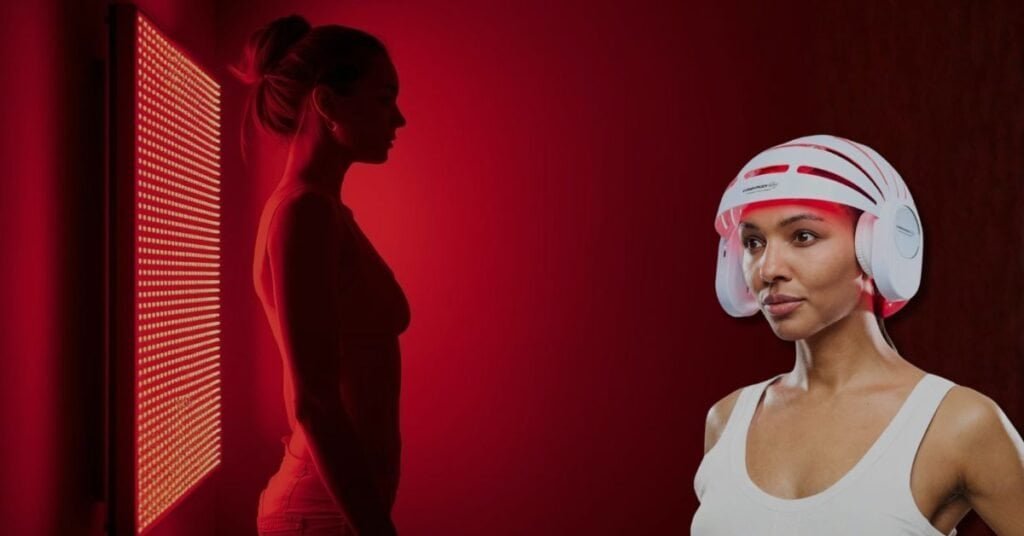
I already love red light therapy for my skin, so I started researching whether it could help my hair, too. I have a red light therapy panel that I use almost daily, but I wanted to know if it’s worth starting to use it on my scalp, or if it’s worth investing in a dedicated red light helmet or hat that is designed specially for hair growth. Let’s go through what the science actually says and figure out what is happening with our hair during perimenopause, and which device makes sense.
TL;DR
Panel vs helmet for hair growth in perimenopause: A helmet wins if hair loss is your main concern – better scalp coverage, hands-free, more consistent results. A panel is the better choice if you want one device for face, body, and scalp, or if you’re on a smaller budget.
Timeline: Expect 16-26 weeks of consistent use (3-4 sessions per week) before you see measurable change.
One thing to remember: The evidence is strongest for androgenetic pattern hair loss, which is the most common type in perimenopause. Sudden diffuse shedding needs a doctor first.
Why does hair change in perimenopause?
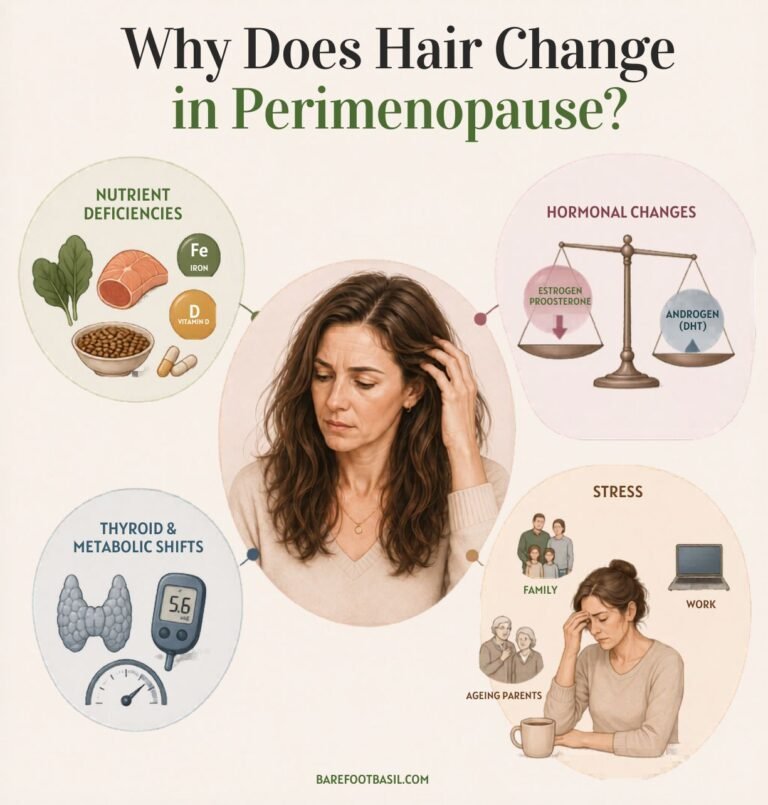
Even when nothing has changed in your routine, hair can start behaving differently in perimenopause; this is what I have been noticing lately. It’s usually not just one thing, but multiple factors adding up.
Nutrient deficiencies. As we age, our bodies absorb nutrients less efficiently. The two that affect hair the most are iron and vitamin D. Iron feeds the dividing cells inside your follicles, and low stores drive shedding (1). Aim for ferritin between 40-60 ng/mL for healthy hair (2). Vitamin D is also important because your hair follicles have receptors for it, and low levels can cause hair loss (3). Get both tested before you even consider a red light therapy device for hair growth.
Hormonal changes. Estrogen and progesterone drop while androgens fall more slowly, and that imbalance changes everything about how your hair grows. Estrogen normally keeps follicles in their growth phase longer and maintains blood flow to your scalp (4). When it falls, scalp circulation reduces, and follicles get less oxygen and nutrients, and hair starts growing slower and thinner (5). Progesterone shifts also affect DHT, the form of testosterone that reduces the size of follicles and can cause pattern hair loss.
Thyroid and metabolic shifts. Perimenopause is when women start experiencing thyroid problems, insulin resistance, and blood pressure changes that are all linked to hair changes (6, 7). If your hair is shifting alongside fatigue or weight changes, ask your doctor for a full thyroid panel – not just TSH.
Stress. Midlife stress hits hair through hormones, immune response, and inflammation at the follicle (8). And we’re juggling a lot in our 40s – careers, kids, marriage, ageing parents, plus perimenopause itself.
Diet, sleep, ferritin and vitamin D optimisation, and stress management are the foundations of healthy hair. No device is going to grow your hair more than sorting these things first. But once those are being addressed, red light therapy is one of the more evidence-backed tools to add to your hair routine.
I’ve had great results with red light therapy on my skin (see my reviews of the Project E Beauty LumaLux Face LED Mask and the Nanoleaf 6-in-1 Wand). The science for hair is promising, especially in perimenopause, because the mechanism targets almost exactly what declining estrogen disrupts.
When red light therapy works for hair growth
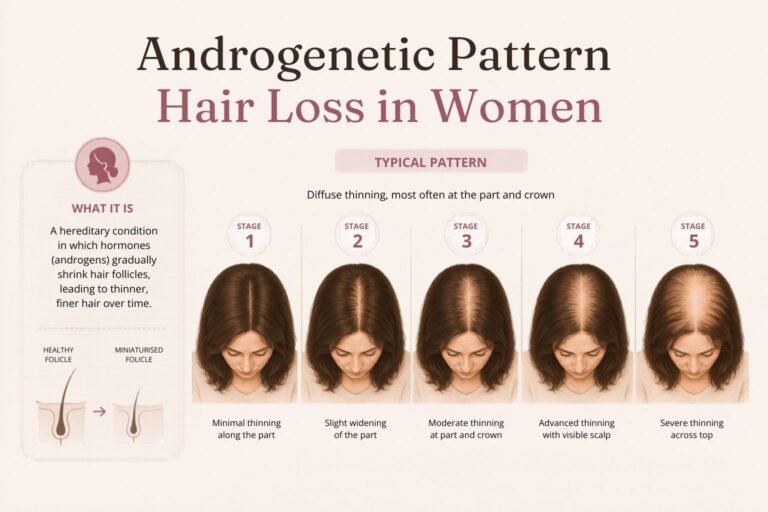
Red light therapy works best for androgenetic pattern hair loss, thinning at the crown, and widening part line, which is the most common type in perimenopause. It’s less useful for sudden diffuse shedding (telogen effluvium), patchy hair loss, scalp inflammation, or scarring – see a dermatologist first for those.
What is important when choosing a red light device for hair growth
It doesn’t matter if you choose an LLLT helmet or a red light therapy panel – these are the things that are important if you want results.
Wavelength. The studied range for hair is 630-680nm (red). Some devices add 800-850nm (near-infrared), which penetrates deeper, but the hair follicle bulge – the bit you’re trying to stimulate – sits only 1-4mm down. Red light reaches it easily. Avoid any device that just says “red light therapy” without specifying wavelength.
Irradiance and dose. Most studies use 3-5 J/cm² per session. More isn’t better; too much red light therapy actually reduces results. Cheap helmets with high-power diodes can do more harm than good.
Session time. Most clinical protocols run 10-25 minutes, 3-4 times a week. If a device needs hour-long sessions or only a few minutes, it might not be worth your money.
FDA clearance. The cleared brands have submitted data to the FDA showing their devices do what they claim. Most cheap Amazon helmets have not. Clearance isn’t a guarantee of results, but it’s a meaningful filter when you’re spending hundreds of dollars. A red light therapy device should be a once-in-a-lifetime investment, and FDA clearance gives you confidence you’re getting what you pay for.
LED vs laser. You’ll see some devices marketed as “laser” and others as “LED.” For hair growth specifically, the evidence shows no meaningful difference between the two – wavelength matters far more than the source. I cover this in detail in my upcoming helmet roundup, where I evaluate specific devices.
Red Light Therapy Panel vs LLLT Helmet
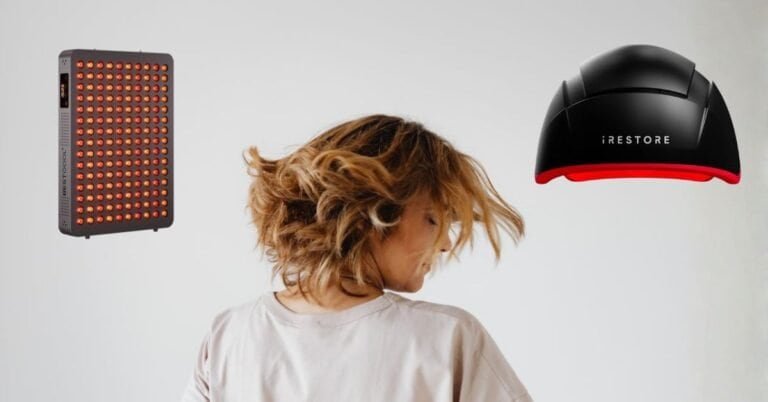
Get Red Light Therapy Panel If. A red light therapy panel is great if you want one device for face, body, and scalp, and you have a smaller budget. Panel is also ok if your hair loss is very mild and you’re using red light therapy as a prevention. The trade-off is that you’ll need to spend a bit more time on setting up, and you will have to stay still while using the panel. This makes keeping the consistency a bit trickier.
Get Red an LLLT Helmet Or Cap If. A helmet is the better choice if hair loss is your primary concern. Better scalp coverage, hands-free use, and the convenience mean that you will be able to stick with it more and will see better results sooner. If you’ve been losing hair for a while and want to take it seriously, a helmet is the more committed choice. I also think it is a very good investment if you share it with your partner.
The honest middle ground. You can absolutely treat your scalp with a quality panel – I do. But you’ll have to be deliberate about coverage, and it’ll probably take longer to see changes than it would with a helmet. If hair is your main concern and your budget allows, an LLLT helmet is a better option, not because most of them have lasers, but because it is designed for hair. If you want one device that does multiple things and you’re patient with the process, a panel works too.
How to combine red light therapy with other hair growth treatments
Red light therapy works, but it works better when stacked with other things. Think of it as one tool in your hair growth routine, not the whole strategy.
Minoxidil. Stacking LLLT with minoxidil has been shown to significantly increase hair growth compared to either treatment alone (15). Apply minoxidil after your red light session, and keep it well away from your pets, it’s highly toxic to cats and dogs. If you’re new to minoxidil, do your own research on side effects and start slow.
The foundations. None of this works if your ferritin, vitamin D, thyroid, or cortisol are off. Get bloodwork done first, fix what needs fixing, and then layer red light therapy on top.
My honest opinion
After researching red light therapy for hair growth in depth, I think it is worth adding to a perimenopause hair routine, but which device is right for you is very personal.
If hair loss is bothering you and you can afford a device built specifically for it, get a helmet or a cap. You’ll use it more consistently, and you’ll see results faster than with a panel. The hands-free convenience is the difference between “I’ll do it later” and actually doing it.
If your hair loss is mild and you want red light therapy as prevention, or you want one device that works on your face, body, and scalp, go with a panel. You’ll get the hair benefits with the bonus of using it for skin and overall wellbeing – which is what I’m doing right now while I decide whether to invest in a helmet.
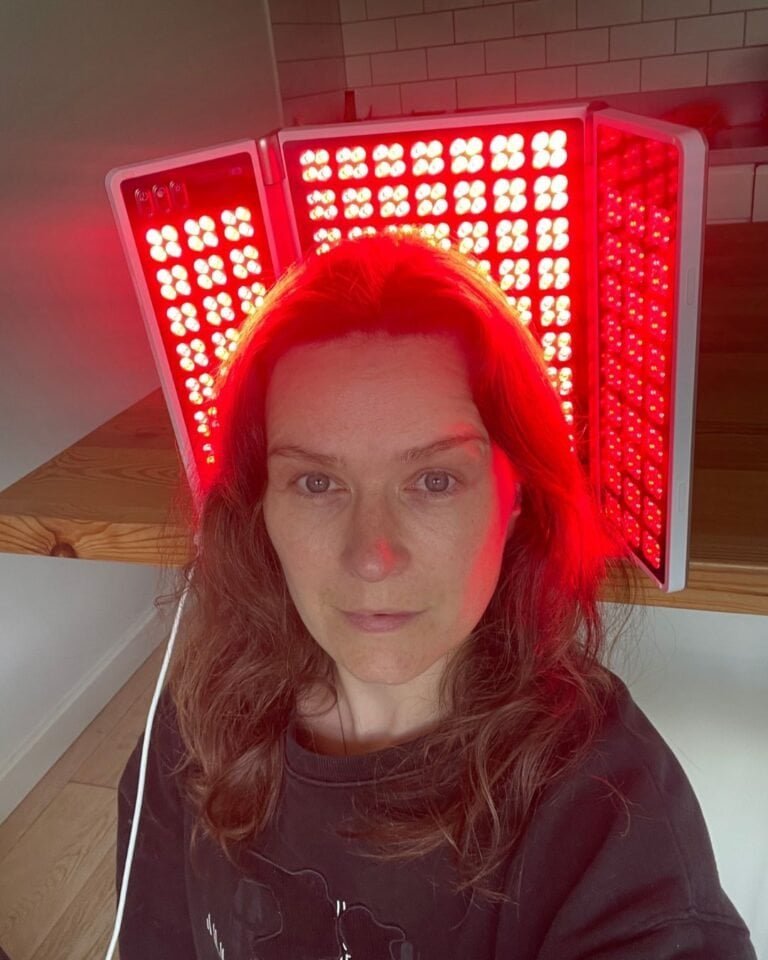
The reason I love using a red light therapy panel for hair growth is that I have a unique Project E Alora Age Renewal LED Light Therapy Panel. It has 3 different panels that I can fold around my head and cover pretty much all of my scalp in one go. You can check my review and discount code for this panel here.
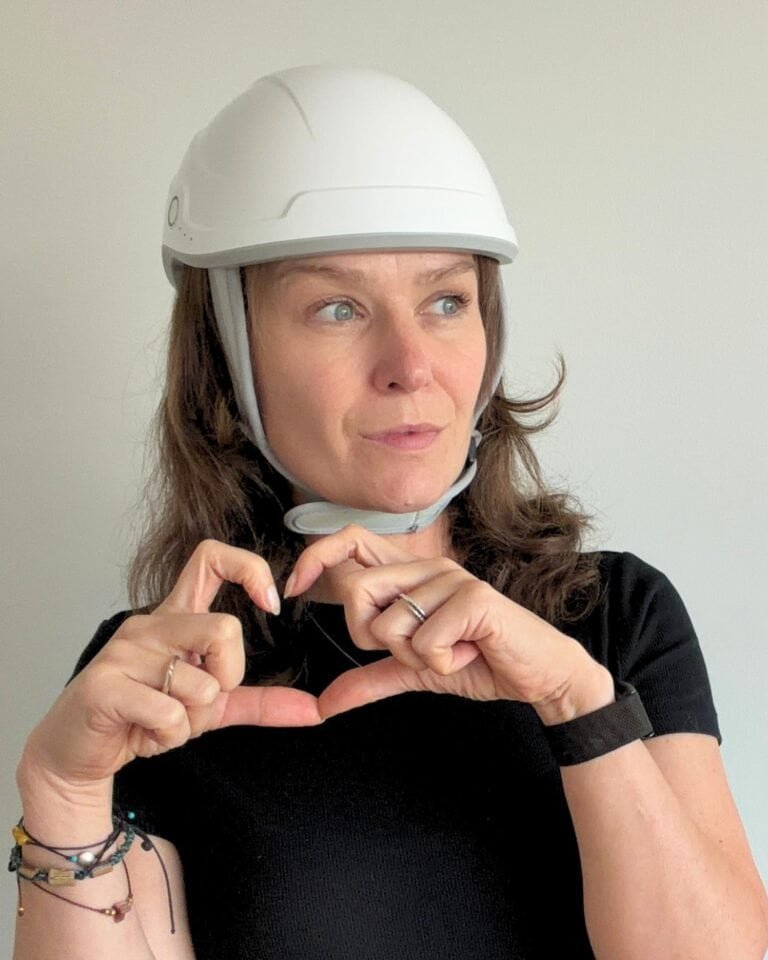
I have finally got my hands on an LLLT hair growth helmet and have been using it for over a month. I am not going to lie; it is so much more convenient to use, and I am way more consistent than with a panel, as I can move around the house while wearing it. If you want to learn more, check out my full review of the Viqure Hair Growth Helmet.
Found this review helpful?
Get more honest recommendations in your inbox.
Thank you!
You have successfully joined our subscriber list.
FAQ
How often do you use red light therapy for hair growth?
Use it 3-4 times a week, 10-25 minutes per session. Studies show this is the sweet spot, and daily usage isn’t better, because your follicles need recovery time between sessions to actually respond. Expect 16-26 weeks of consistent use before you start seeing changes.
Does red light therapy work for hair loss?
Yes, for androgenetic pattern hair loss specifically. Multiple randomized trials show LLLT increases hair count and thickness, with the strongest evidence at 16-26 weeks of consistent use.
Does red light therapy regrow hair that’s already gone?
Not really. Red light therapy works by stimulating follicles that are still alive but underperforming. Once a follicle has completely gone, no red light therapy will bring it back. The earlier you start, the more follicles there are to work with.
How long until I see results from red light therapy?
3-4 months of consistent use before you see a visible change. Some women notice less shedding earlier, around 6-8 weeks, but actual hair count differences take longer. If you’re not seeing anything by 6 months, the device probably isn’t right for you – or something else is driving the hair loss.
Is a laser better than an LED for hair growth?
No. Current studies show no meaningful difference between laser and LED devices for hair growth – what matters most is the wavelength and dose. Laser devices tend to cost two to three times more without delivering proportionally better results. I cover this in detail in my upcoming helmet roundup.
Can I use red light therapy with minoxidil?
Yes. Apply minoxidil after your red light session. There’s research showing LLLT enhances minoxidil’s effectiveness when used together. Watch for any scalp irritation and keep minoxidil away from your pets; it’s highly toxic to them.
Is red light therapy safe for color-treated hair?
Yes. Red light therapy targets your scalp and follicles, not the hair shaft itself, so it doesn’t affect coloured hair. The wavelengths involved (630-680nm and 800-850nm) don’t have enough energy to damage hair dye or cause fading. If anything, healthier follicles produce stronger new growth, which holds colour better.
Does red light therapy work for diffuse thinning or only pattern hair loss?
The strongest evidence is for androgenetic pattern hair loss – the gradual thinning at the crown and part line that’s most common in perimenopause. For diffuse thinning caused by telogen effluvium (sudden shedding from stress, illness, or nutrient deficiency), red light therapy probably won’t hurt, but you need to address the underlying cause and speak with your doctor first.
Can red light therapy help perimenopausal hair loss specifically?
Yes, as long as it’s androgenetic pattern hair loss – thinning at the crown and widening part line, which is the most common type in perimenopause. The mechanism (improving cellular energy and scalp circulation) addresses exactly what falling estrogen disrupts.
How often should I use a red light therapy helmet or panel?
For best results, use it 3-4 times a week, or every other day. Daily use isn’t harmful, but it isn’t necessary either – your follicles need the recovery window between sessions to respond to the stimulus.
To conclude,
Red light therapy isn’t a miracle – no device is. But it’s one of the few hair growth tools with real science behind it, and the mechanism makes biological sense for what perimenopause is doing to our hair. Whether you go with a panel or a helmet, give it 16-26 weeks of consistent use before deciding if it’s working for you.
I’ll be reviewing specific helmets and caps in my next article, so if you want help choosing a device, keep an eye out for that.
Have you tested red light therapy for hair growth? Comment below with your results – I’d love to hear your experience.
Editorial Note: This post is for informational purposes only. Product formulations can change; always check current ingredient labels before purchasing.
References
- Nasrin, T., Wahab, M., Lubna, E., & Khondker, L. (2024). Association of serum ferritin with chronic diffuse alopecia in female patient. World Journal of Advanced Research and Reviews. https://doi.org/10.30574/wjarr.2024.22.2.1562.
- Lin, C., Chan, L., Wang, J., & Chang, C. (2023). Diagnosis and treatment of female alopecia: Focusing on the iron deficiency-related alopecia. Tzu-Chi Medical Journal, 35, 322 – 328. https://doi.org/10.4103/tcmj.tcmj_95_23.
- Saini, K., & Mysore, V. (2021). Role of vitamin D in hair loss: A short review. Journal of Cosmetic Dermatology, 20, 3407 – 3414. https://doi.org/10.1111/jocd.14421.
- Gupta, A., Economopoulos, V., Mann, A., Wang, T., & Mirmirani, P. (2025). Menopause and hair loss in women: Exploring the hormonal transition.. Maturitas, 198, 108378. https://doi.org/10.1016/j.maturitas.2025.108378.
- Rinaldi F, Trink A, Mondadori G, Giuliani G, Pinto D. The Menopausal Transition: Is the Hair Follicle “Going through Menopause”? Biomedicines. 2023 Nov 14;11(11):3041. doi: 10.3390/biomedicines11113041. PMID: 38002043; PMCID: PMC10669803. https://pubmed.ncbi.nlm.nih.gov/38002043/
- Rinaldi, F., Trink, A., Mondadori, G., Giuliani, G., & Pinto, D. (2023). The Menopausal Transition: Is the Hair Follicle “Going through Menopause”?. Biomedicines, 11. https://doi.org/10.3390/biomedicines11113041.
- , 박., & Chang, C. (2013). A Study on the Factors Affecting Alopecia among Women in Middle Age. , 19, 1161-1165. https://doi.org/10.3390/biomedicines11113041
- Salhab, O., Khayat, L., & Alaaeddine, N. (2022). Stem cell secretome as a mechanism for restoring hair loss due to stress, particularly alopecia areata: narrative review. Journal of Biomedical Science, 29. https://doi.org/10.1186/s12929-022-00863-6.
- Hamblin MR. Photobiomodulation for the management of alopecia: mechanisms of action, patient selection and perspectives. Clinical, Cosmetic and Investigational Dermatology. 2019;12:669-678. https://pmc.ncbi.nlm.nih.gov/articles/PMC6737896/
- Effects of photobiomodulation on human hair dermal papilla cells with various light modes and light parameters. Journal of Photochemistry and Photobiology B: Biology. 2024. https://www.sciencedirect.com/science/article/abs/pii/S1011134424002409
- Pillai JK, Mysore V. Role of low-level light therapy (LLLT) in androgenetic alopecia. Journal of Cutaneous and Aesthetic Surgery. 2021;14(4):385-391. https://pmc.ncbi.nlm.nih.gov/articles/PMC8906269/
- Avci P, Gupta GK, Clark J, Wikonkal N, Hamblin MR. Low-level laser (light) therapy (LLLT) for treatment of hair loss. Lasers in Surgery and Medicine. 2014;46(2):144-151. https://pmc.ncbi.nlm.nih.gov/articles/PMC3944668/
- Neema S, Mannu A, Vasudevan B, Sandhu S, Vendhan S, Radhakrishnan S. (2025). Low-level light therapy versus topical 5% minoxidil in the management of androgenetic alopecia in males: A randomised controlled trial. Medical Journal Armed Forces India, 81(4), 445-452. 10.1016/j.mjafi.2024.03.006
- Lanzafame RJ, Blanche RR, Chiacchierini RP, Kazmirek ER, Sklar JA. (2014). The growth of human scalp hair in females using visible red light laser and LED sources. Lasers in Surgery and Medicine, 46, 601-607. https://doi.org/10.1002/lsm.22277
- Mawu, F., Sondakh, O., Kairupan, T., & Christopher, P. (2025). Comparative efficacy and safety of low-level laser therapy and topical Minoxidil combination vs. topical Minoxidil monotherapy in androgenetic alopecia management: a systematic review and meta-analysis of randomized controlled trials. Lasers in Medical Science, 40. https://doi.org/10.1007/s10103-025-04593-7.

Silvija Meilunaite, PN1-NC, CSMC, is a certified nutrition coach and menopause coaching specialist. Combining current scientific research with her own experience of perimenopause, she writes evidence-based articles, practical guides, and in-depth product reviews to help women over 40 make informed decisions about nutrition, strength training, recovery, supplements, non-toxic living, and wellness products.