Hair health is one of the most talked-about topics this year in the wellness industry, with red light therapy and LLLT becoming popular. There are many studies highlighting that, especially combined with other treatments, it can be beneficial for hair growth and even reverse some kinds of hair loss.
Many women in perimenopause ( including me) are suffering from hair density and texture changes, and I cover it in more detail in my article Red Light Therapy for Hair Growth in Perimenopause. If you are already familiar with the benefits and are looking for an LLLT helmet at a very reasonable price, this is a review for you.
I have received my LLLT hair growth helmet from ViQure, and I am super excited to test it out. I have tested the ViQure laser hair growth helmet for a few weeks now and will be updating this article as I use it for longer.
Why trust this review? Here's how I research, test, and score every product.
Quick Verdict
This ViQure laser hair growth helmet is an FDA-cleared, amazing budget option. Yes, it takes 90 minutes a week, and it has a lower number of diodes compared to other helmets, but it delivers proven wavelength and irradiance light to help stimulate your hair growth, and it is way more affordable than anything else on the market.
Quick Verdict (build & value): 8.5/10 – FDA-cleared, well-specced for the price, easy to use.
Results verdict: Pending; I’ll update this with real photos and my honest take at the 3-month and 6-month marks.
Use barefoot15 for 15% OFF the ViQure Hair Growth Helmet.
Disclosure: The ViQure Hair Growth Helmet was gifted to me for review. All opinions are my own, and this review will be updated as I continue testing the device. I may also earn from affiliate links, at no extra cost to you. Thank you for supporting Barefoot Basil! Full Affiliate Disclosure
Why do I want a red light therapy helmet?
I love using a red light therapy mask and panel, and I can definitely see the results on my skin and recovery. Lately, I noticed increased hair shedding, and my hair became drier and puffier than usual. I am trying to get my ferritin levels a bit higher and also want to see if adding LLLT can help me maintain hair growth, as I read many studies about the benefits of LLLT for hair growth and health.
My two main concerns are overall thinning of the hair and slightly more thinning in my temple area. I keep seeing a lot of baby hairs around my temples, but it seems like they never grow longer than 5cm in this region, so I want to see if an LLLT helmet will help my hair grow longer.
I also want to improve my hair’s overall health and appearance, as even if I don’t colour it and mostly air-dry it, my hair still feels dry and not very healthy.
What's in the box and first impressions
In a cute square box, you receive:
- a hair growth helmet,
- velvet storage pouch,
- charging cable
- user manual.
Use barefoot15 for 15% OFF the ViQure Hair Growth Helmet.
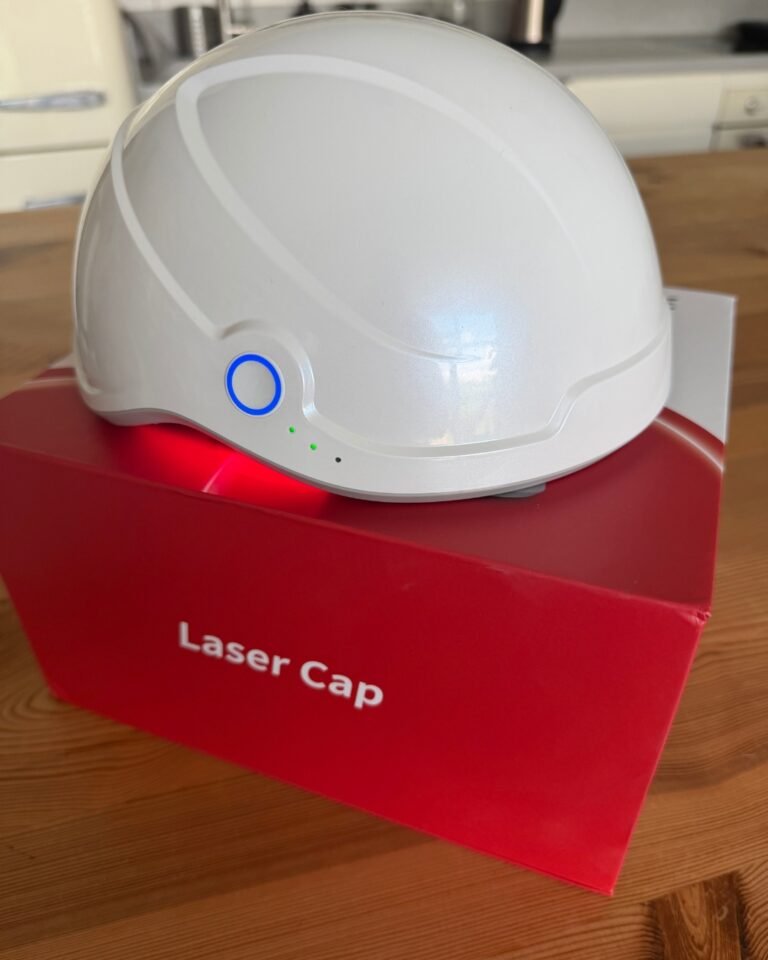
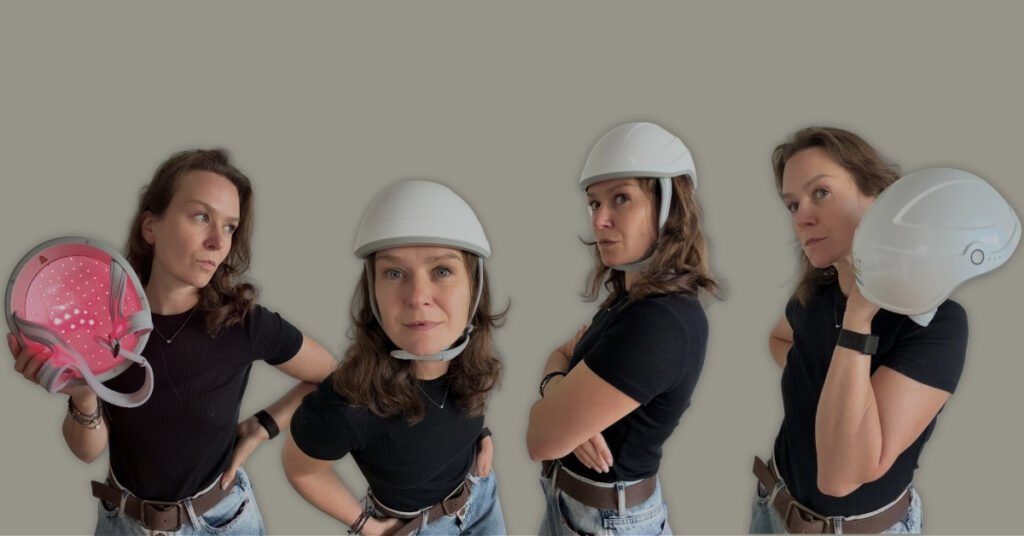
The helmet arrived in a cute box and has everything you need. It is not too heavy to keep on the head for 30 minutes. I love that the straps keep it secure on my head, and I can work, cook, or do light stretching or meditation whilst wearing it.
The control is very simple, literally one button. You can set a continuous or pulsing setting. I am not sure if I will ever use a pulsing setting, as the device does get slightly warm after 30 minutes, but does not get hot. To be honest, I only noticed it getting a bit warm after removing it and touching the inner surface.
I like that it beeps before shutting down after 30 minutes, so you don’t need to guesstimate the time.
You can also see how much charge is left in your helmet, so you don’t need to guesstimate:
3 lights means 80 to 100% power left
2 lights – 50 to 80%
1 light – charge is less than 50%
When the light is flashing, it means the power is less than 20%, and you should charge the helmet before use.
ViQure LLLT Helmet Specifications:
There are three types of red light therapy helmets and hats out there: laser, LED, or Laser and LED combined. If you want to dive deep into the differences, I cover all of this in my article comparing different hair growth devices. ViQure helmet only has Laser diodes that have more focused, deeper-penetrating light.
| Specification | Value |
|---|---|
| Laser Wavelength | 650nm |
| Type of Light | Low-Level Laser Therapy (LLLT) |
| Irradiance | 3.54 mW/cm² |
| Energy Dose | 6.372 J/cm² delivered during one 30-minute treatment |
| Laser Power | 5mW ±20% |
| Classification | Laser Class 3R |
| Number of Laser Diodes | 82 × 650nm laser diodes |
| Life Time | 5 years |
It is also FDA-cleared 510(k), which is amazing for such an affordable hair growth helmet.
What do the specifications really mean?
The specifications are good, and they fall within the range for stimulating hair follicles, although there isn’t a universally agreed “optimal” dose.
| Specification | ViQure Cap | My Assessment |
|---|---|---|
| Wavelength | 650 nm | Excellent |
| Number of Lasers | 82 | Good |
| Power per Laser | 5 mW | Standard |
| Irradiance | 3.54 mW/cm² | Good |
| Energy Dose | 6.37 J/cm² | Good |
Wavelength
650nm is right in the middle of the most studied range for hair growth (630-680nm ); therefore, it is an excellent choice for this device.
Number of lasers
82 lasers is one of the lower numbers on the market, and most other hair growth helmets use anywhere from 96 lasers to 300 lasers and also add LEDs, but the key here is to look at the price, as this helmet costs $300 at the time of writing and none of the competitors come even close to this price. You can check other helmet and cap options in the article Best Red Light Therapy Helmets And Caps For Hair Growth.
Is 82 lasers enough? I suppose it depends on your needs. My focus is to maintain my hair from falling out and help new hair grow, but I am not experiencing severe baldness that needs very concentrated treatment. I think this is an entry-level helmet, and this is reflected in the price as well as the number of diodes.
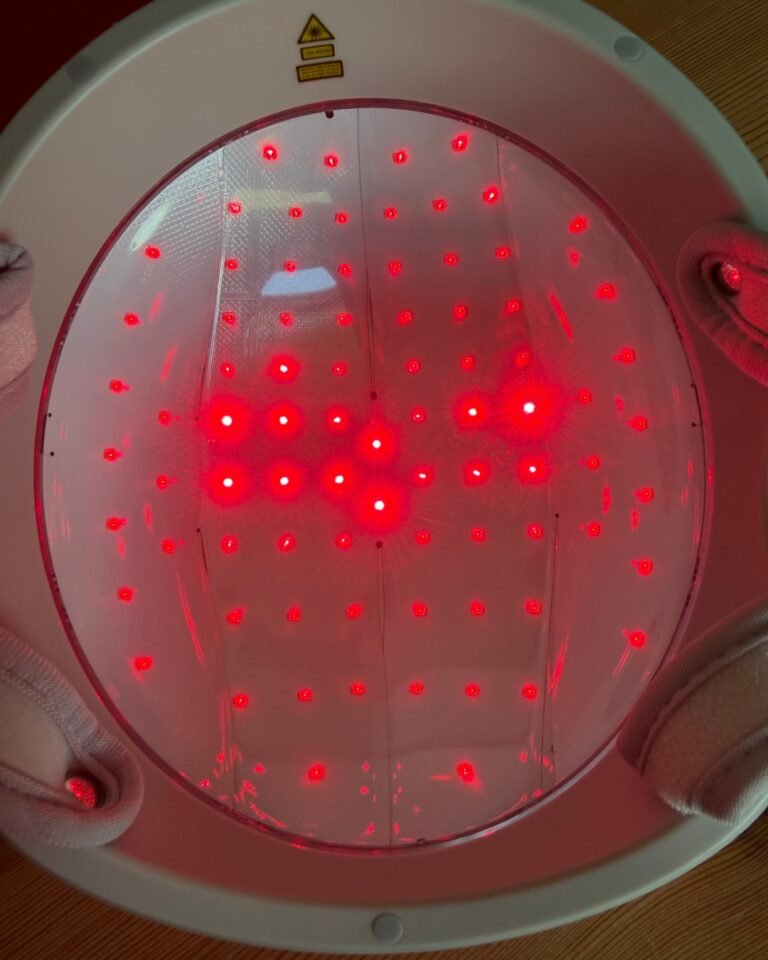
Irradiance: 3.54 mW/cm²
This is the power reaching each square centimetre of the scalp.
Hair growth studies have used a fairly wide range, often around:
- 2-10 mW/cm²
- sometimes slightly higher
So 3.54 mW/cm² is perfectly reasonable but slightly on the lower side, but higher is not always better in Red light therapy. In photobiomodulation, there’s a concept called the biphasic dose response (Arndt-Schulz law) (1), where not enough light has little effect, but too much can reduce the effectiveness (2).
Energy dose: 6.37 J/cm²
This is arguably the more important figure because it represents the total light energy delivered during a treatment.
Many photobiomodulation researchers consider approximately:
- 3-8 J/cm² a common therapeutic range
- around 4-6 J/cm² is frequently used in studies on hair growth
- Much above 10-15 J/cm² may not provide additional benefit for hair follicles and could even be less effective
So 6.37 J/cm² delivered during one 30-minute treatment sits in what many researchers would consider an appropriate therapeutic range.
To summarise the specifications,
This helmet has fewer diodes and needs a longer treatment time, but it provides irradiance and energy in studied ranges and could still work; it’s also the cheapest LLLT hair growth helmet out there. Slightly lower irradiance means it is harder to overdo it, so even if the session is longer, the light is delivered more slowly and gently.
I would give the technical score around 8 out of 10, keeping the price in mind.
What I like about the ViQure Hair Growth Helmet
- I like that it is wireless and has straps to secure the helmet on my head so I can move around
- I like that it beeps when your session is over, so I know when to take it off
- It has wavelengths, irradiance, and energy dose supported by science
- The price for the laser helmet is hard to beat!
- It is not too heavy for the 30-minute session
- Slightly lower irradiance makes it harder to overdo it, and your hair is stimulated longer with gentler irradiance.
- It is FDA-cleared
What could be better
- A 30-minute session is a bit long, but to be honest, I never felt it was too bad, as I normally use the helmet when I am working on my laptop or doing housework or gentle exercise
- The number of diodes could be increased to make sure there are not many gaps in the coverage
- It is quite bulky and would not be something I take with me when I travel
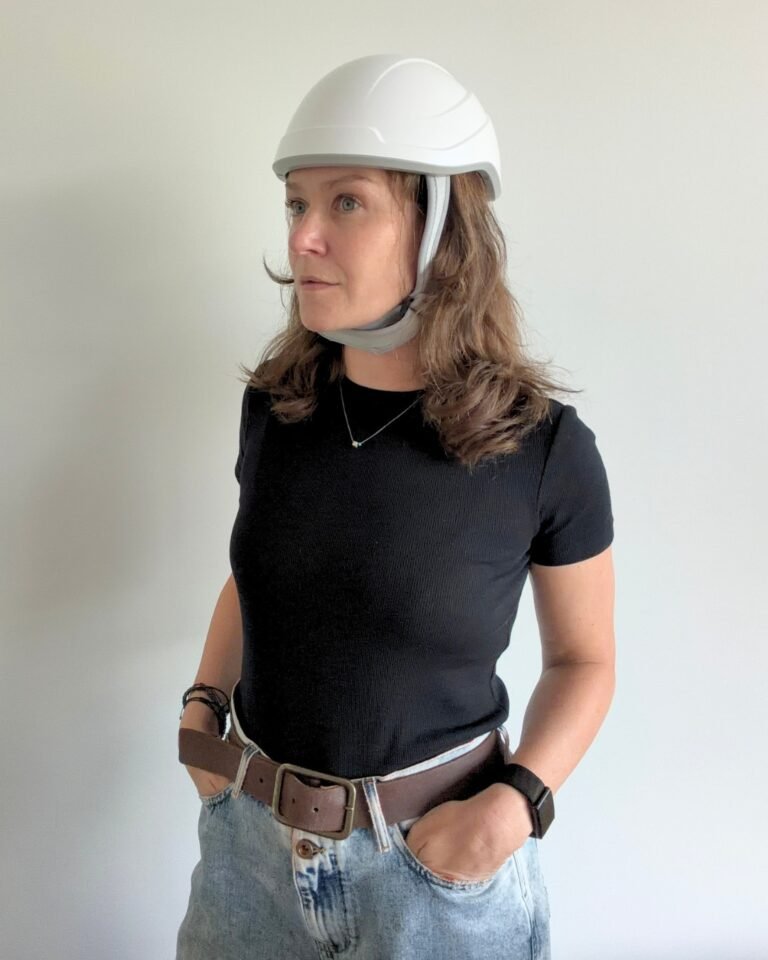
- It does look like a construction helmet, and I would not be comfortable wearing it outside the house, but all LLLT helmets are not fashion accessories and do not look sexy, to be honest.
Who should buy the Viqure LLLT Hair Growth helmet?
I would recommend this specific hair growth helmet:
- If you are experiencing mild to moderate hair loss
- If you want to maintain hair growth
- If you have Fitzpatrick skin types I and IV
- If you are using treatments like Minoxidil or peptide serum and want to help the treatments be better
- If you want to improve your hair density and growth
- If your hair bothers you, but you are not quite ready for a hair transplant
- If you are noticing changes in your hair quality due to perimenopause
- If you are committed long-term to using the device
Use barefoot15 for 15% OFF the ViQure Hair Growth Helmet.
Who should not buy it?
You should check all these points before you decide to get yourself an LLLT helmet, and you should not buy it if:
- If you will not be able to allocate 30 minutes every other day for the treatment
- If you have Fitzpatrick skin types V and VI
- If you are taking medications or have medical conditions that make your skin sensitive to light exposure.
- If you have a scalp injury or serious medical conditions, consult your medical provider first
- If you have had your hair chemically permed, wait a month to use the helmet.
- If your hair loss is beyond treatable severity or an untreatable type, you can check all out on the ViQure website.
- If you want fast results
- If you have very thick hair, that would obstruct lasers from getting to the scalp
- If you are pregnant or nursing.
If you are interested in learning more about the Viqure brand and their products, I have also reviewed their S-LD Hair Removal Device here.
Is the ViQure LLLT hair growth helmet suitable for women in Perimenopause?
Yes, this helmet is suitable for both women and men. In its FDA clearance, the statement is this:
“Laser Cap is indicated to promote hair growth in males with androgenic alopecia who have Norwood-Hamilton classifications of IIa-V or females with androgenic alopecia who have Ludwig-Savin Classifications of I-II and both with Skin Phototypes I-IV.”
I do feel that, for men who have short hair and the bolding is quite noticeable, the monitoring at home might be way easier than for women with long hair, so even in my review, as much as I want to be very precise, it will be way harder to monitor the growth as I don’t have very noticeable bolding patches.
Another thing to keep in mind is that hair might actually obstruct the laser from getting to the hair follicle, so theoretically, at least this is my thinking, women, or anyone with longer hair, probably might need more sessions to see the results. Laser (as in this helmet) potentially could be slightly better than LEDs, as they emit more focused light and could shine through the hair.
Found this review helpful?
Get more honest recommendations in your inbox.
Thank you!
You have successfully joined our subscriber list.
FAQ
How to clean the ViQure LLLT hair growth helmet?
Keeping the ViQure LLLT hair growth helmet clean is very straightforward. I wipe it with a damp cloth after every use and store it in a provided pouch to keep it away from dust.
Do you need special preparation before using the ViQure LLLT hair growth helmet?
No, you don’t. I avoid using the helmet if I have a lot of product in my hair, and I only use it when my hair is clean. I try to move the hair away from the parts that I want to do the most. My main concern is the temple area, so I move my hair away to keep that part of my scalp more exposed to the lasers. I would avoid using any hair clips or hair bands that would obstruct the lasers from reaching the scalp.
How long do I need to use the ViQure Hair Growth helmet to see results?
Hair growth is not a quick process, and you need to use the helmet for a minimum of 4 months, with the best results starting to show in month 6,5 (26 weeks).
How often should I use the ViQure Hair Growth helmet?
You should use the helmet 3 times a week, 30 minutes per session, so 90 minutes per week. Please note that if you stop using the helmet, your hair might go back to how it was.
Do hair growth helmets work?
Yes, they do, but only for certain hair loss and hair/skin types, and as long as they have the right wavelength, irradiance, and energy dose, and you use them regularly.
To summarize,
ViQure Hair Growth Helmet is a good investment for someone who wants to improve their hair growth and quality. It is not the most powerful, nor does it have the most laser diodes on the market, but it is definitely the most affordable LLLT helmet. If your budget is tight but you want a device with proven wavelength irradiance and energy dose, it is a great product for hair growth.
So far, I love using it, and I will update the article with my personal results in a few months.
Health Disclaimer: This post is for informational purposes only and is not medical advice. Always consult a qualified healthcare professional before making changes to your supplements, medications, or treatment plan, particularly during perimenopause or if you have an existing health condition.
References
- Huang YY, Sharma SK, Carroll J, Hamblin MR. Biphasic dose response in low level light therapy – an update. Dose Response. 2011;9(4):602-18. doi: 10.2203/dose-response.11-009.Hamblin. Epub 2011 Sep 2. PMID: 22461763; PMCID: PMC3315174. https://pmc.ncbi.nlm.nih.gov/articles/PMC3315174/
- Zungu IL, Hawkins Evans D, Abrahamse H. Mitochondrial responses of normal and injured human skin fibroblasts following low level laser irradiation–an in vitro study. Photochem Photobiol. 2009 Jul-Aug;85(4):987-96. doi: 10.1111/j.1751-1097.2008.00523.x. Epub 2009 Feb 13. PMID: 19222797. https://pubmed.ncbi.nlm.nih.gov/19222797/

Silvija Meilunaite, PN1-NC, CSMC, is a certified nutrition coach and menopause coaching specialist. Combining current scientific research with her own experience of perimenopause, she writes evidence-based articles, practical guides, and in-depth product reviews to help women over 40 make informed decisions about nutrition, strength training, recovery, supplements, non-toxic living, and wellness products.