

A few years ago, you would not have seen me going out without a layer of sunscreen all over my body and face, especially on holiday. My skin is very pale, so I need to make sure it is protected before I turn into a lobster. My obsession with sunscreen increased after a very close friend had a cancerous mole removed after we spent a holiday together.
I used to buy the cheapest sunscreen and cover myself before I stepped a foot outside.
However, after learning more about toxic ingredients used in the cosmetic industry, I have realised that sunscreen is one of the most toxic things we put on our bodies daily. I must choose a sunscreen that will not disturb my hormones, as they are already up and down due to perimenopause.
I have created this guide to help you choose the best sunscreen that will protect you from the sun. You will learn which sunscreen ingredients to avoid and how to choose a sunscreen that is kind to your body and the environment.
Chemical VS Mineral sunscreens, what is the difference?
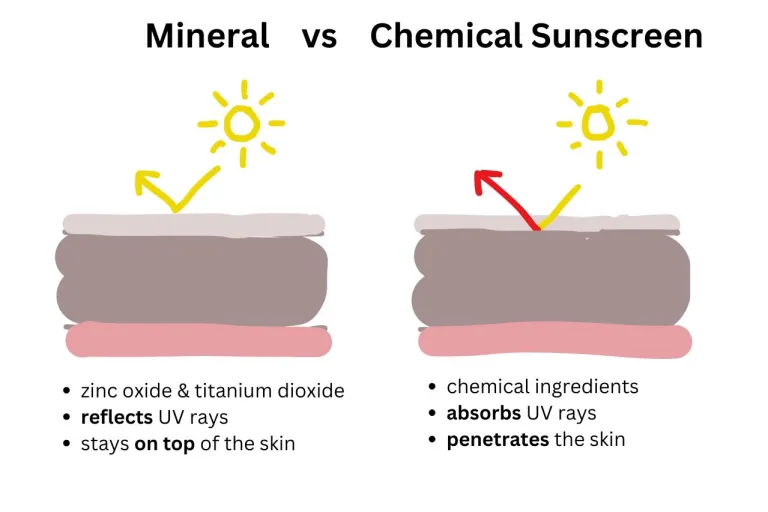
Sunscreens use active ingredients to either absorb or reflect radiation from the sun, stopping it from damaging our skin. There are two main types of sunscreens: Chemical and Mineral.
Chemical Sunscreens use Absorbers:
These ingredients absorb UV radiation and convert it into heat, which is then released from the skin. Standard chemical absorbers are:
- Oxybenzone
- Avobenzone
- Octocrylene
- Octinoxate
- Homosalate
Mineral sunscreens use Physical Blockers:
These ingredients reflect UV radiation away from the skin. Common physical blockers are:
- Titanium dioxide
- Zinc oxide
Cosmetic brands follow a multi-step testing process to ensure the safety of their products. Testing includes both individual ingredients and the final formulations.
Formulations must comply with regulations set by authorities like the FDA in the US and the European Commission in the EU to ensure product safety.
Sunscreen-producing brands analyse how much of the product a consumer would use in the worst-case scenario and leave a safety margin for ingredients of concern, so even if we go overboard, the product would still be safe to use.
All ingredients used in sunscreens are tested, used only in small quantities, and are deemed safe for humans, so why should we even be worried?
Why do we need to be careful about the sunscreens we use?
I have a few reasons for choosing sunscreens with the safest and cleanest formulations, and I apply this logic to sunscreen and other beauty and skincare products.
- These days, we use multiple products multiple times a day to keep our largest organ – our skin – moisturised, clean, and safe. We apply cleansers, moisturisers, serums, sunscreens, shower gels, shaving foam, shampoos, conditioners, masks, etc.
Then we add all the beauty products – concealers, foundation, blushes, highlighters, eyeshadows, setting sprays, mascaras, lipsticks, lip liners…then come hair sprays, tanning lotions, nail polish, parfumes…..
All these products are a very recent addition to human lives; never before have people been applying so many chemicals (even if tested and safe in small amounts) to our skin. We just don’t know how deep all these products can penetrate and what effect a mixture of them has on our internal body, hormones, and general well-being.
- Yes, a lot of ingredients are vigorously tested and are considered safe, but are they all tested in so many mixtures? There are so many different ingredients and combinations in all the products we apply on top of each other that it is pretty much impossible to test them all. To add to this point, science is evolving, and we have more and more data, and we can discover that what was thought safe a few years ago might actually not be.
- In addition to impacting our bodies, many of the ingredients used in sunscreens are harmful to the environment, mainly marine life. Chemical sunscreens containing oxybenzone and octinoxate can contribute to coral reef bleaching. It is great to see many holiday destination countries bringing more awareness to this, and some only sell coral-safe sunscreens, but then again, some sunscreens might be coral safe but not be as safe to our bodies.
What Ingredients to avoid in sunscreens?
Here are the most commonly used hazardous ingredients in sunscreens that can potentially harm us and the environment.
1. OCTOCRYLENE (UV FILTER) It has been proven to be an endocrine disruptor, affecting hormone regulation in humans and wildlife (1) and can also cause allergic reactions (2).
2. BHT (BUTYLATED HYDROXYTOLUENE). It can be carcinogenic in rodents (3). Like Octocrylene, it is a potential endocrine disruptor that can affect reproductive health and hormone balance(3).
3. METHYLENE BIS-BENZOTRIAZOLYLTETRAMETHYLBUTYLPHENOL. It can cause skin allergic reactions (4) and is also persistent in the environment, posing risks to aquatic life (2).
4. BUTYLPHENYL METHYLPROPIONAL (FRAGRANCE). It is a skin irritant (5) and can affect reproductive health and development in animals(6).
5. METHYLISOTHIAZOLINONE. It can be neurotoxic (7) and is also a potent allergen, causing contact dermatitis and allergic reactions(8).
Many more chemicals in sunscreens could potentially harm us, but these are the main ones present and highlighted in most of the sunscreens I have analysed on the Yuka app.
Several sunscreen ingredients are known to harm the environment, particularly marine ecosystems and coral reefs. These ingredients can contribute to coral bleaching, damage marine life, and accumulate in aquatic ecosystems. Most of these harmful ingredients for the environment are in chemical sunscreens and other cosmetic products.
Why Sunscreen Ingredients Matter Even More During Perimenopause?
If you’re a woman in your 40s and already dealing with the hormonal rollercoaster of perimenopause, sunscreen choice becomes more important.
During perimenopause, our oestrogen and progesterone levels are already fluctuating unpredictably. Our endocrine system is working overtime trying to find a new balance. The last thing we need is to add external hormone disruptors found in our sunscreen.
Oxybenzone and homosalate have shown signs of oestrogenic activity in lab studies, leading to the European Commission’s Scientific Committee restricting their use in 2021, stating that they are not safe at the concentrations still allowed in the US (12)(13).
I’m not saying one application of sunscreen with oxybenzone and homosalate will disbalance your hormones. But when you’re applying it every single day, on top of moisturisers, serums, and makeup, it adds up. And when your hormonal system is already under stress, reducing exposure to hormone disruptors is quite important.
This is one of the reasons I tend to use mineral sunscreens with non-nano zinc oxide or titanium dioxide, especially on my body. They sit on top of the skin rather than being absorbed into the bloodstream, so there’s no endocrine disruption concern. It’s a simple swap that gives me one less thing to worry about during a phase of life that already comes with enough surprises.
If you want to know which sunscreens I actually recommend, check out my best non-toxic sunscreens guide.

Sunscreen Ingredients that harm the environment
“Homosalate and octocrylene are the most toxic UV filters for marine organisms, potentially posing a risk in the future if concentrations continue to increase.”(11)
- Oxybenzone (Benzophenone-3) is linked to coral bleaching and can damage coral DNA (9). It can disrupt hormone function in marine life and can be toxic to algae, sea urchins, fish, and mammals (10).
- Octinoxate (Ethylhexyl Methoxycinnamate) also contributes to coral bleaching and affects marine organisms’ development and reproductive systems.
- Octocrylene can accumulate in aquatic organisms and cause developmental and reproductive toxicity. It can also degrade into benzophenone, which is a potential carcinogen.
- Homosalate can accumulate in the environment and has been detected in various aquatic organisms. It is a potential endocrine disruptor.
- 4-Methylbenzylidene Camphor (4-MBC) is an endocrine disruptor and can affect the hormonal balance of marine life. It is also persistent in the environment.
- Parabens (e.g., Butylparaben) can disrupt hormone function in marine organisms and have been linked to coral bleaching.
- PABA (Para-Aminobenzoic Acid) can be toxic to marine life.
Some regions, such as Hawaii and parts of the Caribbean, have banned sunscreens containing these chemicals to protect marine life. We should not wait till all governments catch up and make conscious decisions ourselves.
I don’t know about you, but every time I go snorkeling in the sea, I want to make sure the sunscreen from my skin is not killing our beautiful marine life, already fighting for survival.
What sunscreens are the best to use?
It really depends on your needs and when you are using it. Chemical sunscreen might be perfect for the face day to day, as it doesn’t clog your pores, doesn’t have a white cast, and generally sits way nicer than mineral sunscreen. But if you are planning to use sunscreen in the water, while snorkeling and spending time in the sea, you have to choose a sunscreen that will not harm the environment and will not pollute the water, and also is water-resistant for longer periods of time, so you need to apply it less frequently.
The safest sunscreen formulations use non-nano zinc oxide or titanium dioxide as their active ingredients, which provide broad-spectrum UVA and UVB protection without harmful chemicals.
Non-nano zinc oxide and titanium dioxide are considered the safest sunscreen ingredients due to their minimal skin penetration, low irritation, and photostability. They are a good alternative to chemical sunscreens. But there are also many chemical sunscreen formulations that not only protect but also nourish your skin, without any harmful ingredients.
What SPF sunscreen should I use?
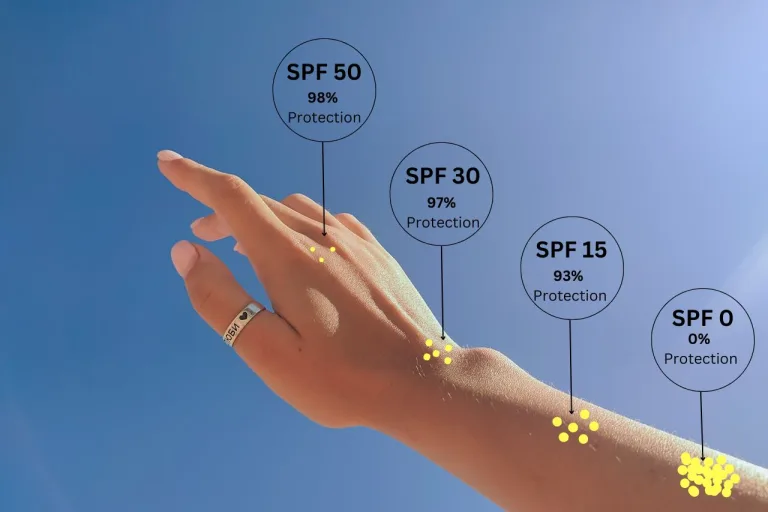
Ideally, you should always go for SPF 50 sunscreen, as you can see in the picture below, SPF 30 is still great, and the protection is only 1% weeker than SPF 50%. So ideally, use SPF 50%, but don’t sweat it if the only choice in the shop is 30 %, it is still way better than no sunscreen.
What I would also remind you of is to cover up. Linen long Clothes are perfect for summer as they are very light, breathable, and comfortable. And don’t forget to cover your head and face with a hat, it will prevent sun damage as much as the strongest sunscreen.
There are so many different sunscreens, and it is extremely difficult to find the one that suits your skin type, feels nice, and also does not harm the environment. I have created a list of the best non-toxic sunscreens to make your life easier.
Key takeaways
Research shows that most of the products we use on our skin are safe, and we shouldn’t bin them all. Sunscreens have a very good purpose: to protect our skin from harmful UV rays and to prevent skin disease and ageing. We should use them daily.
- Choose mineral sunscreen if you can, and it suits your skin type and tone
- If you choose Chemical sunscreen, look at the ingredient list and try to avoid the five listed above, or use a Yuka product scanning app to guide you
- Make sure you use only marine life-safe sunscreen if you are swimming or snorkelling in water. The Yuka app can be helpful
- Don’t be scared of using sunscreen; even with harsh ingredients, it is better than no sunscreen when spending time in the sun
Conclusion
This post is not about scaring you to avoid all potentially harmful ingredients. It is about guidance and education, and understanding your choices and their impact. When choosing a sunscreen, the best thing to do is to use common sense and factors like availability and affordability, but also find a product that suits your skin type.
For example, finding a mineral sunscreen that doesn’t clog your pores and cause acne can be difficult if your skin is oily. If you have darker-toned skin, it will be even more difficult.
I do try to use the same sunscreens that I know fit my skin type, protect me from sun damage, and also don’t have any endocrine-disrupting ingredients. This, however, is a bit tricky when you are a digital nomad, so I found the Yuka app very helpful, especially in places like Thailand or Croatia, where I would not be able to find my usual sunscreens.
Editorial Note: This post is for informational purposes only. Product formulations and research in this area can change – always check current sources and ingredient labels.
- Krause, M., Klit, A., Jensen, M., Søeborg, T., Frederiksen, H., Schlumpf, M., Lichtensteiger, W., Skakkebæk, N., & Kt, D. (2012). Sunscreens: are they beneficial for health? An overview of endocrine disrupting properties of UV-filters.. International journal of andrology, 35 3, 424-36 . https://doi.org/10.1111/j.1365-2605.2012.01280.x.
- Ludriksone, L., & Elsner, P. (2021). Adverse Reactions to Sunscreens.. Current problems in dermatology, 55, 223-235 . https://doi.org/10.1159/000517634.
- Park, E., & Seong, E. (2020). Methylisothiazolinone induces apoptotic cell death via matrix metalloproteinase activation in human bronchial epithelial cells.. Toxicology in vitro : an international journal published in association with BIBRA, 104661 . https://doi.org/10.1016/j.tiv.2019.104661.
- Barrientos, N., Abajo, P., Celada, R., Vega, M., & Domínguez, J. (2019). Allergic contact dermatitis caused by phenylbenzimidazole sulfonic acid included in a sunscreen. Contact Dermatitis, 81, 151 – 152. https://doi.org/10.1111/cod.13271.
- Groot, A., & Frosch, P. (1997). Adverse reactions to fragrances. Contact Dermatitis, 36. https://doi.org/10.1111/j.1600-0536.1997.tb00418.x.
- Murawski, A., Fiedler, N., Schmied-Tobies, M., Rucic, E., Schwedler, G., Stoeckelhuber, M., Scherer, G., Pluym, N., Scherer, M., & Kolossa-Gehring, M. (2020). Metabolites of the fragrance 2-(4-tert-butylbenzyl)propionaldehyde (lysmeral) in urine of children and adolescents in Germany – Human biomonitoring results of the German Environmental Survey 2014-2017 (GerES V).. International journal of hygiene and environmental health, 229, 113594 . https://doi.org/10.1016/j.ijheh.2020.113594.
- He, K., Huang, J., Lagenaur, C., & Aizenman, E. (2006). Methylisothiazolinone, A Neurotoxic Biocide, Disrupts the Association of Src Family Tyrosine Kinases with Focal Adhesion Kinase in Developing Cortical Neurons. Journal of Pharmacology and Experimental Therapeutics, 317, 1320 – 1329. https://doi.org/10.1124/jpet.106.103044.
- Cahill, J., Toholka, R., & Nixon, R. (2014). Methylisothiazolinone in baby wipes: a rising star among causes of contact dermatitis. Medical Journal of Australia, 200. https://doi.org/10.5694/MJA13.10946.
- Downs, C., Kramarsky-Winter, E., Segal, R., Fauth, J., Knutson, S., Bronstein, O., Ciner, F., Jeger, R., Lichtenfeld, Y., Woodley, C., Pennington, P., Cadenas, K., Kushmaro, A., & Loya, Y. (2016). Toxicopathological Effects of the Sunscreen UV Filter, Oxybenzone (Benzophenone-3), on Coral Planulae and Cultured Primary Cells and Its Environmental Contamination in Hawaii and the U.S. Virgin Islands. Archives of Environmental Contamination and Toxicology, 70, 265-288. https://doi.org/10.1007/s00244-015-0227-7.
- Ziarrusta, H., Mijangos, L., Picart-Armada, S., Irazola, M., Perera-Lluna, A., Usobiaga, A., Prieto, A., Etxebarria, N., Olivares, M., & Zuloaga, O. (2018). Non-targeted metabolomics reveals alterations in liver and plasma of gilt-head bream exposed to oxybenzone.. Chemosphere, 211, 624-631 . https://doi.org/10.1016/j.chemosphere.2018.08.013.
- Thorel, E., Clergeaud, F., Jaugeon, L., Rodrigues, A., Lucas, J., Stien, D., & Lebaron, P. (2020). Effect of 10 UV Filters on the Brine Shrimp Artemia salina and the Marine Microalga Tetraselmis sp.. Toxics, 8. https://doi.org/10.3390/toxics8020029.
- https://health.ec.europa.eu/system/files/2022-08/sccs_o_244.pdf
- https://health.ec.europa.eu/publications/benzophenone-3_en

Silvija Meilunaite, PN1-NC, CSMC, is a certified nutrition coach and menopause coaching specialist. Combining current scientific research with her own experience of perimenopause, she writes evidence-based articles, practical guides, and in-depth product reviews to help women over 40 make informed decisions about nutrition, strength training, recovery, supplements, non-toxic living, and wellness products.


Thank you for sharing this, very insitfull. I have so much more knowledge about sunscreens now 🙂