
Strength training for women over 40 is finally getting the attention it deserves. For years, we were told that cardio and yoga were the answer, that the goal was to stay small and skinny, and that lifting was something men did. So it is good to see that change.
But somewhere along the way, the message swung too far the other way. If you love lifting and feel at home in a gym, none of this will faze you, and that is amazing. For the rest of us, the advice started to feel extreme and a little intimidating. Every time I open Instagram, my feed is full of women who look like bodybuilders, and instead of inspiration, I freeze. And my local gym’s weight room, full of guys and influencers, is not exactly where I feel my most confident.
And I was thinking to myself, if I, with all the certifications and knowledge, feel like this, surely many women know that strength training after 40 is crucial but don’t know where to start.
Here is what I want you to know: I try to strength train as much as possible. I go to classes, I use the outdoor gym near my home, and I keep a set of resistance bands for full-body work on the days I stay in. I am also a Certified Menopause Coaching Specialist, but I still feel intimidated.
This guide is for the woman over 40 who wants to get stronger but is not ready to walk into the CrossFit gym, yet. Strength training does not need a fully kitted gym. You can start with your own body weight and a few simple tools, build strength training into everyday life, like carrying the shopping, and progress from there. Let me show you how.
Key Takeaways
- You do not need a gym. Start with just your body weight and a few simple tools, then progress from there.
- This is the moment it matters most. Muscle and bone loss speed up in perimenopause, so your 40s are the time to start, not your 60s.
- Go slow and get the technique right first. Staying consistent and injury-free matters far more than lifting heavy.
- Aim for 3 to 4 short sessions a week – though 2 still counts, and even 10 minutes adds up. Everyday carries and squats in the kitchen count too.
- The hardest part is showing up. A partner or a booked class keeps you accountable when motivation dips, and it will.
Why Strength Training Matters More After 40?
Perimenopause is the time of fluctuating and declining estrogen, which is linked to muscle loss, bone loss, abdominal fat gain, insulin resistance, sleep and mood changes, and musculoskeletal pain(7)(6).
Strength training is one of the key things you can do to live a healthy life for longer. From about age 40, our muscle strength and power decline faster, and we need to maintain or try to gain more muscle to stay mobile and healthy well into very old age (1).
I am so happy to see way more women picking up heavier weights in the gym and not being scared to push themselves; however, I can still hear women in strength training classes saying “my arms are big already; I will use smaller weights” or “I don’t want to be too bulky”. We definitely need to shift our thinking about strength training from aesthetics to health. Here are the benefits of strength training for women over 40:
Slowing Muscle & Strength Loss
And it is never too late. Studies show that even people over 60 and 85+ can increase strength gains by 30–45% in 8–18 weeks of strength training (2).
Function, Independence, and Falls
And it is not only about the strength but also the general quality of life as we age. Strength training improves walking speed, balance, agility, and ability to perform daily tasks, reducing fall risk and keeping your independence for longer (3).
Bones Density
Your bones start losing density quickly in perimenopause, especially in late perimenopause, around a year before your final period. Many women only discover bone loss much later, when it is harder to turn around. That is exactly why strength training matters in your 40s, not at 60. Loading your bones and muscles through resistance training is one of the few things shown to help protect bone density in perimenopause (7).
Multiple studies show that progressive resistance training increases bone mineral density in older adults (4).
Metabolism and Disease
Strength training has been shown to improve insulin and fasting glucose, which also leads to lower fat mass and higher muscle mass (5).
Quality of Life, Mood, and Longevity
As well as physical benefits, strength training can be beneficial for pain relief, and can improve your mood and energy levels, which can even help with socializing and general life quality (8)(9)(10).
I can definitely feel it when I exercise, without overpushing myself, I feel in a much better mood and have more energy. And with perimenopause hitting me hard, I definitely appreciate the boost. I also notice my back pain becomes way more manageable if I am consistent with my training. The more I move, the less pain I feel.
How to start strength training as a middle-aged woman?
The key is to start slowly. Don’t overdo it, and don’t injure yourself. Begin with your own body weight and learn the technique first. Get the movements right, then move on to weights or other equipment like resistance bands.
Strength training does not have to be complicated. Think about it: years ago, nobody had gyms or personal trainers; people just moved more. All you are really doing is giving your body a bit of physical stress so it can build and hold on to muscle. I always come back to the old saying, if you don’t use it, you lose it. So the first job is simply learning how to use your muscles more.
You do not need a fully equipped gym at the beginning of your journey. Your strength training sessions do not need to be an hour long. Start with 10 minutes and build up.
Look up a few simple bodyweight exercises on YouTube, things like planks, squats, and lunges, and learn the basics. Start with several repetitions you can manage and build them up slowly. Once your squat or lunge feels solid, you can start adding resistance bands. They might not look like much, but they make your muscles work, and you will feel the burn.
You might be thinking you have to lift heavy to see results. Heavy lifting has its place, but consistency and staying injury-free matter more, especially at the start. You can build muscle with lighter loads too, as long as you do enough repetitions to properly challenge the muscle, so that the last few reps feel genuinely hard.
Here are some good YouTube resources you can start with:
Best Glute Workouts for Women on YouTube 2026
The Best Leg Workouts for Women
Best At-Home Abs Workouts for Women
In short, start with a simple exercise with your body weight, do it for 10 minutes a day, and progress slowly.
Recovery is as important as the training in your 40s
As it takes a bit longer for us to recover after we hit 40, you need to train a bit more mindfully to make sure your body has time to recover. If you pushed hard and can feel your muscles aching, give them some time to recover.
I like to take a magnesium salt bath, take Magnesium Glycinate Supplements and use my red light therapy panel on aching muscles.
If you want to do strength training two days in a row, exercise lower body one day and upper body the other day, so the specific muscles have more time to recover.
Recovery does not mean lying in bed all day; you can still exercise, but choose something more gentle. Recovery days are great for focusing on your mobility and pelvic floor health, both of which are often overlooked when starting strength training I have created great lists for you to check out:
Best Mobility Workouts: From Hip Mobility Exercises to Full-Body Flow
The Best Pelvic Floor Exercises for Women to Practise at Home
Make sure to eat enough protein and carbs so your body has enough energy to repair and grow muscle.
Drinking water, having sufficient amounts of electrolytes, and creatine can also aid muscle growth.
In short, you need enough time to rest in between resistance training sessions as well as hydrate and eat enough to fuel your muscles.
How To Strength Train Outside Your Gym Hours?
It is just as important to keep your body moving outside your training hours, because the little bits add up. I do squats in the lift, or whenever I get up for a glass of water, and you can fit them into any small break, even on the walk to the toilet from your desk. Ten squats every time you stand up soon turn into a lot of squats by the end of the day.

Carrying things counts too. It is so convenient to have groceries delivered, but I prefer to do the weekly shop with my partner so we each carry a heavy bag home. That walk back is free strength work.
You can take this further with a weighted vest on your dog walks, on a walking pad, or even while you do chores like hoovering or mopping. Some people will say that is not enough, and on its own, it is not a full workout, but it is far better than nothing and a really good place to start. If you would rather not buy a vest, load a backpack with a few heavy books and wear it on your walks instead. As you get stronger and feel ready for more, you can also add small weights to your wrists or ankles during everyday movement.
Equipment, from zero to an increased resistance and weight
There is a misconception that strength training only works with heavy weights or gym machinery. But this is simply not true, and if you have never lifted weights and start with heavy equipment, you will end up injuring yourself.
To begin, all you need is your body; there are some exercises that I still perform with no weights at all. This is a progression diagram for strength training.
Bodyweight, resistance bands, ankle weights, weighted vests, dumbbells, kettlebells, heavy weights.
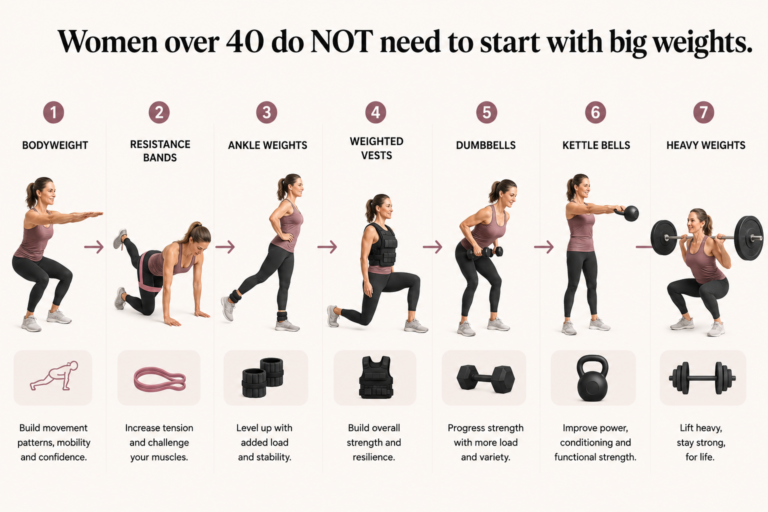
If you are a total beginner, start with your body weight. Many exercises will make your muscles burn. This stage is all about learning techniques and building resilience. After a few weeks or a month, you can start introducing a bit more resistance or weights. I would recommend adding a resistance band first. You can get different kinds for specific exercises.
If you don’t know how to choose resistance bands for your needs, I have compiled the best resistance bands and exercises for them in this article:
Best Resistance Bands for Women Over 40
Normally, there are multiple resistance bands in the set; you can progress by resistance and also use multiple bands to make it even harder. After resistance bands, you can progress to weights, add some ankle weights, and add dumbbells to your training.
Most of my training consists of a mixture of different resistance bands and a few different weight dumbbells.
I always use lighter weights for my upper body and heavier weights for lower body exercises.
If you are looking for ankle weights, check out:
Best Ankle Weights for Women Over 40.
I also have a list of great weighted vests for women here.
How do I keep up with strength training?
Staying consistent is usually the hardest part, especially in the beginning. Most of us stop not because the exercises are too hard, but because being accountable only to ourselves is tough. This is where other people help. Find someone you can answer to, whether that is a friend, your partner, or a personal trainer, and lean on them when your motivation dips, because it will dip.
I exercise with my partner, so we both have to show up for each other. I also book my strength classes a week in advance, and once it is in the diary, I go, no matter how I feel that day. Deciding out of the moment makes it so much easier to keep going.
Plan your week so you know the exact time for your exercise. If I don’t know what time I am exercising on the day, I tend to convince myself that I will do it better tomorrow. So don’t rely on your daily motivation but create routine slots for your workouts, even if they are 10 minutes to start with.
In short. Find something that you like doing, and find a partner or a group to keep it more fun but also to create accountability so you show up even when you don’t feel like exercising.
What are common strength training mistakes in women after 40?
- Starting with way too heavy weights. Start with your body weight and progress. Add light dumbbells or resistance bands only when you have learned the techniques.
- Not warming up, our bodies are a bit more stiff, and we need at least 10 to 15 minutes of solid warm-up, getting the blood flowing and joints lubricating before we even look at the weights
- Pushing too hard and then giving up. Start slow and small and progress slowly.
- Not having a plan and not adding progression. For your muscle to keep growing, you need to push it to new limits every two weeks or so. You can add more resistance (use a stronger band), add more reps or weights, and try to push yourself a bit harder. If you stay the same with your training, your body will not change. Don’t stop with the pink dumbbells; start taking up the space when you are ready. Progression is the key to building muscle mass and bone density.
- Not eating enough. You have to eat protein and carbs to see the results. Your muscles need energy to grow, and without enough calories, you will struggle.
- They think that you need to spend hours in the gym. Even 10-minute straight training sessions add up. Just start and increase the time as you go.
- Not allowing enough time for recovery. With age, it takes a bit longer for our bodies to recover, so listen to your body and let it rest in between sessions.
- Forgetting mobility. Lack of mobility stunts progression and can cause injuries. Make sure to allocate some time before the strength training to warm up, as well as have some mobility sessions in between the strength training days.
Is Pilates or Lagree good as strength training for women?
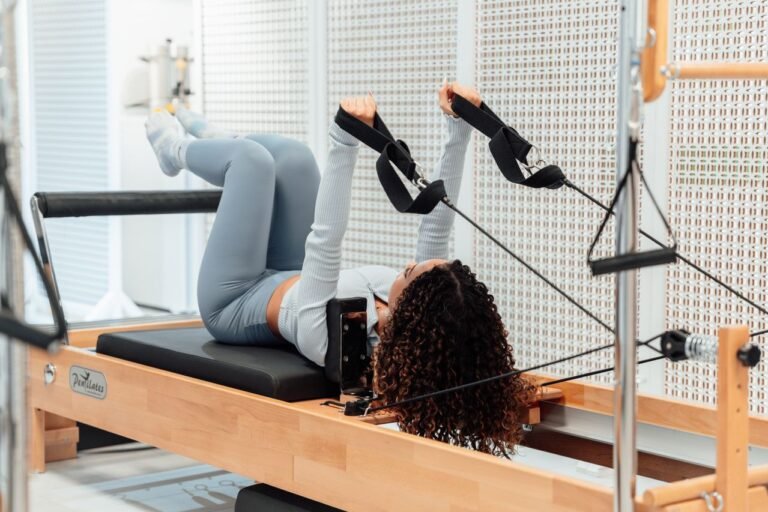
Pilates has taken off in recent years, with reformer studios opening on what feels like every corner. I think the benefits are genuinely great, especially if you are at the very beginning of your strength journey. It is a lovely way to strengthen your core, work on your posture, and get your muscles used to a bit of resistance. If Pilates is the first step you take, go for it, particularly if you enjoy it, because the form of movement you enjoy is the one you will actually keep doing.
I have created Pilates exercise lists with the best Pilates instructors on YouTube, so check them out here:
The Best Free Reformer Pilates Videos On YouTube,
The Best Free Wall Pilates Workouts
If you already love reformer Pilates and the class setting but want to push more towards building muscle, it is worth trying Lagree. It is inspired by reformer Pilates but leans harder into strength and endurance. Lagree is low-impact and time-efficient, often run as short, intense sessions, which makes it a good option if you want strength work in a class environment rather than on a gym floor.
Perimenopause checklist for your doctor's appointment.
So nothing gets missed and dismissed.
Thank you!
Your Perimenopause Symptom Checklist is on its way to your inbox. Welcome to the Barefoot Basil community.
FAQ about Strength Training in Perimenopause
Can I build muscle at home without weights?
Yes, you can. You can start strength training with just your body weight, then add resistance bands when you want a bit more load.
How often should a woman over 40 strength train?
Aim for a minimum of two but ideally three to four sessions a week if you can, working all the major muscle groups. If you only manage two, that is still far better than none, and you can add walks with a weighted vest or a heavy backpack in between. Just remember that recovery takes a little longer after 40, so give your muscles enough rest between sessions.
Is it too late to start strength training at 50?
It is never too late. Research shows that even people who begin in their 60s, 70s, and 80s can regain meaningful strength and function, so 50 is a great time to start (11).
Do I need a gym to strength train?
No, you do not. Gym machines can help you with form and let you add weight safely, which is useful early on, but they are not essential. You can get started with your body weight, resistance bands, light weights, or even heavy household items.
To summarize,
Strength training for us women in our 40s is one of the main things we can do for a healthy, long life, but I do understand that it can be a bit daunting. Start slowly, build your confidence, and build it as a long life habbit. And most of all, have fun!
Health & Safety Note: This post is for informational purposes only. Individual needs vary – if you have any injuries, health conditions, or concerns, consult a healthcare professional before making changes to your exercise or nutrition routine.
References
- Siddique, U., Frazer, A., Avela, J., Walker, S., Ahtiainen, J., Howatson, G., Tallent, J., & Kidgell, D. (2022). Determining the cortical, spinal and muscular adaptations to strength-training in older adults: A systematic review and meta-analysis.. Ageing research reviews, 101746 . https://doi.org/10.1016/j.arr.2022.101746
- Marzuca-Nassr, G., Alegría-Molina, A., SanMartín-Calísto, Y., Artigas-Arias, M., Huard, N., Sapunar, J., Salazar, L. A., Verdijk, L., & Van Loon, L. J. C. (2023). Muscle Mass and Strength Gains Following Resistance Exercise Training in Older Adults 65-75 Years and Older Adults Above 85 Years.. International journal of sport nutrition and exercise metabolism, 1-9 . https://doi.org/10.1123/ijsnem.2023-0087
- Tøien, T., Berg, O., Modena, R., Brobakken, M. F., & Wang, E. (2025). Heavy Strength Training in Older Adults: Implications for Health, Disease and Physical Performance. Journal of Cachexia, Sarcopenia and Muscle, 16. https://doi.org/10.1002/jcsm.13804
- O’Bryan, S. J., Giuliano, C., Woessner, M., Vogrin, S. J., Smith, C., Duque, G., & Levinger, I. (2022). Progressive Resistance Training for Concomitant Increases in Muscle Strength and Bone Mineral Density in Older Adults: A Systematic Review and Meta-Analysis. Sports Medicine (Auckland, N.z.), 52, 1939 – 1960. https://doi.org/10.1007/s40279-022-01675-2
- Wang, J., Fan, S., & Wang, J. (2025). Resistance training enhances metabolic and muscular health and reduces systemic inflammation in middle-aged and older adults with type 2 diabetes: a meta-analysis.. Diabetes research and clinical practice, 112941 . https://doi.org/10.1016/j.diabres.2025.112941
- Arun S Karlamangla, Albert Shieh, Gail A Greendale, Elaine W Yu, Sherri‐Ann M Burnett‐Bowie, Patrick M Sluss, Deborah Martin, Anthony Morrison, Joel S Finkelstein, Anti‐Mullerian Hormone as Predictor of Future and Ongoing Bone Loss During the Menopause Transition, Journal of Bone and Mineral Research, Volume 37, Issue 7, 1 July 2022, Pages 1224–1232, https://doi.org/10.1002/jbmr.4525
- Brynczka, I., Migiel, M., Rypel-Bośka, J., Goleniewska, K., Miaśnikiewicz, J., Ciechomski, K., Cecuła, W., & Stupecka, A. (2025). The Preventive Role of Resistance Training in Perimenopausal Women: A Literature Review. Quality in Sport. https://doi.org/10.12775/qs.2025.47.66781
- Kashi, S. K., Mirzazadeh, Z., & Saatchian, V. (2022). A Systematic Review and Meta-Analysis of Resistance Training on Quality of Life, Depression, Muscle Strength, and Functional Exercise Capacity in Older Adults Aged 60 Years or More. Biological Research For Nursing, 25, 88 – 106. https://doi.org/10.1177/10998004221120945
- Hart, P., & Buck, D. J. (2019). The effect of resistance training on health-related quality of life in older adults: Systematic review and meta-analysis. Health Promotion Perspectives, 9, 1 – 12. https://doi.org/10.15171/hpp.2019.01
- D’Onofrio, G., Kirschner, J., Prather, H., Goldman, D., & Rozanski, A. (2023). Musculoskeletal exercise: Its role in promoting health and longevity.. Progress in cardiovascular diseases. https://doi.org/10.1016/j.pcad.2023.02.006
- Bloch-Ibenfeldt, M., Gates, A. T., Karlog, K., Demnitz, N., Kjaer, M., & Boraxbekk, C. (2024). Heavy resistance training at retirement age induces 4-year lasting beneficial effects in muscle strength: a long-term follow-up of an RCT. BMJ Open Sport & Exercise Medicine, 10. https://doi.org/10.1136/bmjsem-2024-001899

Silvija Meilunaite, PN1-NC, CSMC, is a certified nutrition coach and menopause coaching specialist. Combining current scientific research with her own experience of perimenopause, she writes evidence-based articles, practical guides, and in-depth product reviews to help women over 40 make informed decisions about nutrition, strength training, recovery, supplements, non-toxic living, and wellness products.